UTXO: how Bitcoin tracks balances
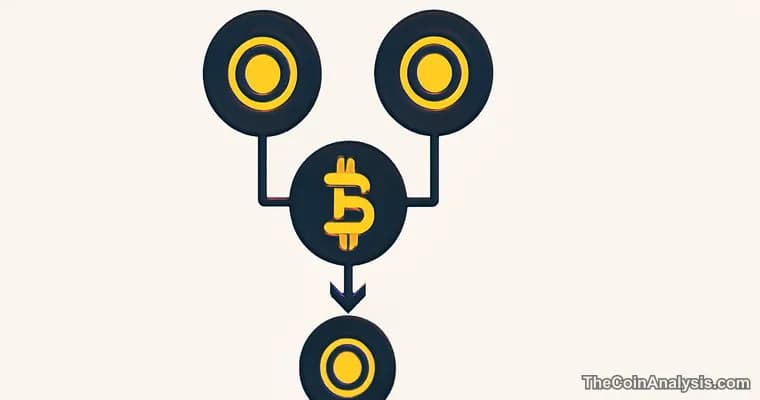
The Bitcoin Accounting Model
UTXO stands for Unspent Transaction Output. Unlike traditional banking systems that track balances in accounts, Bitcoin uses the UTXO model to keep track of ownership and spending. Each UTXO represents a discrete chunk of Bitcoin that has been received but not yet spent. In other words, Bitcoin does not store your balance as a single number; instead, it tracks a collection of these individual outputs. Your wallet's balance is the sum of every UTXO whose locking script you can unlock with your private key.
This model means that every time you receive Bitcoin, you get one or more UTXOs assigned to your wallet’s addresses. Each UTXO is a specific amount of Bitcoin locked by a cryptographic script that only you can unlock. When you want to spend Bitcoin, you select which UTXOs to use as inputs for your transaction, consume them entirely, and then create new UTXOs as outputs. This process is fundamentally different from simply debiting or crediting an account balance.
How Spending Works with UTXOs
When you spend Bitcoin, you do not modify a balance directly—instead, you consume one or more UTXOs completely and create new UTXOs. For example, if you have a 1 BTC UTXO and want to send 0.3 BTC to someone else, your transaction will consume the entire 1 BTC UTXO and generate two new outputs: one sending 0.3 BTC to the recipient and another returning roughly 0.7 BTC back to you as change, minus the transaction fee paid to miners.
This mechanism explains why a single wallet often controls many UTXOs of varying sizes. Over time, as you receive and spend Bitcoin, your wallet accumulates a collection of these unspent outputs. Wallet software must then decide which combination of UTXOs to use when creating a new transaction, balancing factors like minimizing fees and preserving privacy.
Because UTXOs are indivisible and must be spent whole, if you want to send an amount smaller than a UTXO you own, you always generate change outputs. This is somewhat analogous to paying cash: if you hand over a $20 bill for a $7 purchase, you expect $13 back in change. Similarly, Bitcoin transactions return change to your wallet in the form of new UTXOs.
Advantages of the UTXO Model
The UTXO model offers several technical advantages. One key benefit is that transactions are easy to validate in parallel because each UTXO can only be spent once. This property simplifies the detection of double-spends, where someone tries to spend the same output twice, which is a critical security feature for a decentralized currency.
Another advantage is improved privacy compared to account-based systems. Since each UTXO can be assigned to a different address, users can generate new addresses for each transaction, making it harder to link transactions and balances to a single identity. This granular control over outputs helps preserve user privacy on the Bitcoin network.
The UTXO model also aligns well with Bitcoin’s design goals of security and decentralization. Because UTXOs are immutable and independently verifiable, nodes can efficiently validate transactions without needing to track global account states, which helps maintain the robustness of the network.
Challenges and Wallet Management
Despite its advantages, the UTXO model introduces operational complexity for wallets. Wallet software must implement algorithms to select which UTXOs to spend in a transaction—a process called coin selection. Good coin selection strategies aim to minimize transaction fees, reduce the number of inputs to keep transactions small, and avoid revealing unnecessary information that could harm privacy.
If a wallet holds many small UTXOs, spending Bitcoin can become inefficient because transactions with many inputs are larger in size and therefore more expensive to process. Users sometimes consolidate UTXOs by creating transactions that combine many small outputs into fewer larger ones, often during periods of low network fees.
Additionally, UTXO management affects user experience. Since each UTXO corresponds to a specific address and amount, wallets need to track these outputs carefully to display accurate balances and transaction histories. This is different from account-based systems like Ethereum, where balances are updated directly and feel more familiar to traditional banking users.
Comparing UTXO and Account-Based Models
While Bitcoin uses the UTXO model, many other blockchains, including Ethereum, use an account-based model. In an account-based system, each user has a single balance that increases or decreases with each transaction, similar to a bank account. This approach simplifies balance tracking and transaction construction but sacrifices some of the parallel validation and privacy benefits offered by UTXOs.
The UTXO model’s design makes it easier to verify transactions independently and in parallel, which can improve scalability under certain conditions. However, the account-based model can be more intuitive for developers and users building decentralized applications, as it directly reflects balances without managing multiple outputs.
Understanding these differences is important for anyone exploring how cryptocurrencies work under the hood. For a deeper dive into how Bitcoin’s ledger operates compared to other blockchains, see our blockchain explanation.