Mining: how crypto is produced
Creating Crypto Through Computation
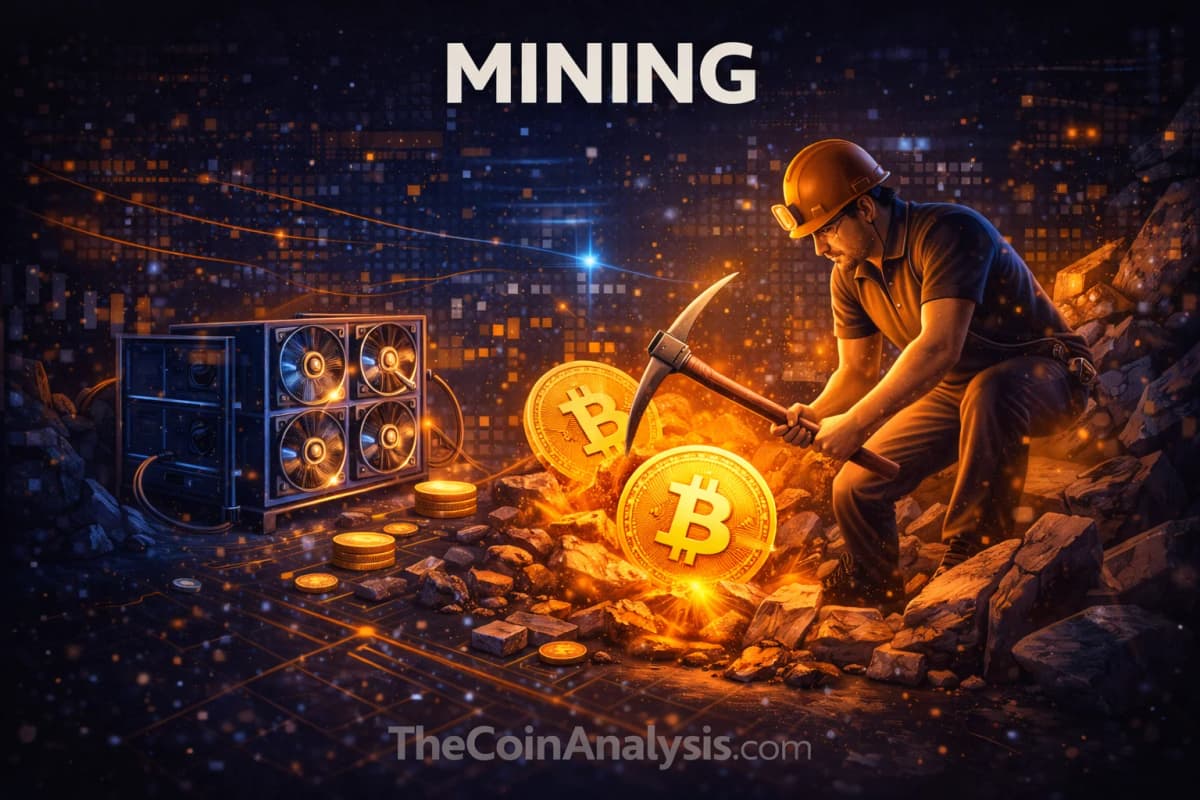
Mining is the process by which Bitcoin and other proof-of-work cryptocurrencies come into existence and maintain their security. Miners deploy specialized computers to solve complex cryptographic puzzles, competing against each other in a computational race. The first miner to find a valid solution earns the right to add the next block to the blockchain and receives newly minted coins plus all transaction fees included in that block.
This mechanism serves two critical functions simultaneously. It creates a fair and predictable way to distribute new coins without relying on a central authority. More importantly, it secures the network by making attacks prohibitively expensive. Attempting to rewrite transaction history would require controlling more computing power than all honest miners combined, a feat that becomes increasingly difficult as the network grows.
The mathematical puzzle miners solve is called a hash function. They must find a number that, when combined with block data and run through the SHA-256 algorithm, produces an output meeting specific criteria. This is essentially sophisticated guessing at enormous scale. Modern mining operations perform trillions of calculations per second, yet finding valid blocks still takes an average of ten minutes by design.
The Evolution of Mining Hardware
Mining technology has undergone several dramatic transformations since Bitcoin launched in 2009. Understanding this evolution helps explain why the industry looks so different today from its early hobbyist origins.
During 2009 and 2010, anyone with a standard computer could mine Bitcoin profitably. The network was small, difficulty was low, and a regular CPU could find blocks with reasonable frequency. Early adopters accumulated thousands of bitcoins using ordinary laptops and desktops. This era established the decentralized ethos of cryptocurrency, where participation required nothing more than running software.
By 2011, miners discovered that graphics processing units offered dramatically better performance for the specific calculations required. GPUs designed for video games turned out to excel at the parallel processing needed for mining. This shift began concentrating mining among those willing to invest in multiple high-end graphics cards and deal with the resulting heat and electricity costs.
The introduction of ASICs (Application-Specific Integrated Circuits) around 2013 changed everything permanently. These chips do nothing except mine cryptocurrency, but they do it thousands of times more efficiently than general-purpose hardware. Within months, CPU and GPU mining became completely obsolete for Bitcoin. The barrier to entry rose substantially as profitable mining required purchasing expensive specialized equipment.
Today, Bitcoin mining operates at industrial scale. Massive facilities house thousands of ASIC machines, consuming megawatts of electricity and requiring sophisticated cooling systems. The largest operations negotiate directly with power companies for favorable rates and locate strategically near cheap energy sources including hydroelectric dams, natural gas flares, and solar installations.
Mining Pools and Solo Mining
The economics of modern mining make solo operation impractical for most participants. With millions of miners competing globally, the probability of any single machine finding a block is extremely low. A typical ASIC might run for years without ever winning a block reward, making income highly unpredictable.
Mining pools emerged to solve this variance problem. Participants contribute their computing power to a collective effort, sharing rewards proportionally based on contribution. This provides consistent, smaller payouts rather than rare jackpots. The tradeoff is that pools charge fees, typically 1-3% of earnings, and introduce some degree of trust in the pool operator.
Pool selection matters beyond just fee comparison. Different pools use various reward distribution methods such as PPS (Pay Per Share), PPLNS (Pay Per Last N Shares), or hybrid approaches. Pool location affects latency and orphan block rates. Reputation and transparency around payments deserve consideration. Diversifying across multiple pools can reduce risk from any single pool experiencing problems.
The Halving Cycle
Bitcoin mining rewards follow a predetermined schedule that halves approximately every four years. When Bitcoin launched, miners received 50 BTC per block. This dropped to 25 in 2012, then 12.5 in 2016, 6.25 in 2020, and 3.125 in 2024. The halving continues until roughly 2140 when all 21 million bitcoins will have been mined.
Each halving significantly impacts mining economics. Revenue per block drops 50% overnight while costs remain constant. Historically, this has forced less efficient operations to shut down while more efficient miners benefit from reduced competition. Price movements around halvings have tended to compensate for reduced block rewards over time, though past patterns do not guarantee future outcomes.
Profitability Factors
Mining profitability depends on a complex interplay of factors that change constantly. Electricity cost is typically the largest ongoing expense. Operations with access to power below $0.05 per kilowatt-hour hold significant advantages over those paying residential rates of $0.15 or higher. Location selection often prioritizes cheap energy above all else.
Hardware efficiency determines how much computation you get per unit of electricity consumed. Newer ASIC generations offer substantial improvements, but they also cost more upfront and depreciate as even newer models arrive. The constant obsolescence cycle means mining is as much about timing equipment purchases as running machines.
Network difficulty adjusts every 2016 blocks (roughly two weeks) to maintain the ten-minute block target. When more miners join, difficulty increases. When miners leave, it decreases. This self-adjusting mechanism means that even if you buy the best hardware and find cheap power, profitability depends partly on decisions made by all other miners globally.
Bitcoin price obviously affects whether mining revenue covers costs. During bull markets, even inefficient operations can profit. Bear markets force marginal miners offline. This cyclicality makes mining a challenging business that rewards long-term thinking and strong financial cushions to survive downturns.
The Environmental Debate
Mining energy consumption generates significant controversy. Bitcoin alone uses more electricity than many countries. Critics argue this represents wasteful environmental damage, particularly when fossil fuels power the operations. The carbon footprint of proof-of-work has become a major talking point for crypto skeptics.
Defenders offer several counterarguments. Mining incentivizes development of renewable energy by providing a buyer willing to consume excess production that would otherwise be curtailed. Many large operations now run primarily on hydroelectric, solar, or wind power. Some miners capture methane from landfills or oil fields that would otherwise be vented into the atmosphere, actually reducing emissions.
The debate remains unresolved because reasonable people disagree about how to weigh costs against benefits. What is clear is that the industry is evolving. Renewable energy adoption continues increasing among miners, driven by both economics and public pressure. Proof-of-stake alternatives eliminate mining entirely, as demonstrated when Ethereum transitioned in 2022 and reduced its energy consumption by approximately 99%.
Getting Started with Mining
For those interested in mining despite the challenges, research thoroughly before investing. Calculate projected returns using realistic assumptions about electricity costs, difficulty increases, and price scenarios. Join mining communities to learn from experienced operators. Consider starting small to understand the operational realities before scaling up.
Alternative approaches exist for those who find traditional mining impractical. Cloud mining services sell hash power without requiring hardware ownership, though scams are common in this space. Mining alternative coins with less competitive networks can work with consumer hardware. Staking offers another path to earning cryptocurrency rewards without mining at all.
Mining remains a fascinating intersection of technology, economics, and energy markets. Whether it makes sense for you depends entirely on your specific circumstances, resources, and appetite for a complex and competitive endeavor.