
Ethereum Chosen for Deep Liquidity
JPMorgan is moving its digital deposit token, JPM Coin, onto the Ethereum blockchain, a decision driven by the network’s established liquidity and widespread institutional adoption. Emma Landriault, global head of Kinexys Labs at JPMorgan’s blockchain division, cited Ethereum’s deep liquidity and existing use among clients as key motivators for this expansion. Currently, almost $50 billion in crypto assets are locked within Ethereum-based applications, underlining the ecosystem’s scale and relevance for large-scale financial operations.
The move comes after JPMorgan previously flagged intentions to expand outside its private networks earlier in the year, including a planned rollout on the Canton Network and support for Base, an Ethereum layer-2 solution developed by Coinbase.
Institutional Clients Drive Blockchain Expansion
JPM Coin is designed exclusively for institutional clients, representing U.S. dollar deposits held at JPMorgan. The token allows these approved participants to transfer funds instantly—within seconds—at any time of day. This 24/7 functionality addresses a longstanding limitation of traditional banking rails that typically restrict high-value transfers to business hours or require batch processing overnight.
JPMorgan’s total payments business processes $12 trillion every day, far surpassing the daily volume handled by Kinexys.
Landriault explained that the bank’s clients include both crypto companies seeking blockchain-native payment rails and traditional financial institutions aiming to settle trades or post collateral more efficiently. Even with its launch on a public network like Ethereum, access will remain strictly limited to pre-approved institutional players; retail users and unvetted entities will not be able to transact with JPM Coin on-chain.
Retail access remains out of reach despite the move onto a public blockchain.
See Also
JPM Coin Goes Beyond Private Networks
Until now, JPM Coin transactions have been confined mainly to Kinexys, JPMorgan’s private blockchain network, which processes over $7 billion daily—just a fraction compared to the bank’s total payments business volume of $12 trillion per day. By bridging to Ethereum, JPMorgan aims to tap into broader liquidity pools and facilitate seamless peer-to-peer transfers within the Ethereum Virtual Machine (EVM) ecosystem.
This expansion follows the November 2025 introduction of JPM Coin on Base. However, while Base is an Ethereum layer-2 solution optimized for speed and cost efficiency, Ethereum mainnet offers unmatched asset diversity and liquidity—factors deemed essential for scaling institutional settlement use cases.
Settlement, Collateral, and 24/7 Payments
With this integration, eligible clients can use JPM Coin not only for rapid payments but also to settle trades and post collateral directly on-chain. Landriault noted that these features are increasingly in demand from both fintechs and legacy players looking to modernize their back-end infrastructure without sacrificing regulatory oversight or counterparty trust. The result is a hybrid model: leveraging public blockchain rails while maintaining strict permissioning at the participant level.
According to coindesk.com, nearly a year after its initial debut, JPM Coin’s utility is being extended precisely because institutional clients are seeking programmable money solutions that match the flexibility of DeFi platforms—without exposing themselves to unregulated risk.
Ethereum Integration: What Changes for Banks?
The backdrop for this expansion is Ethereum’s continued dominance in decentralized finance (DeFi), with almost $50 billion locked in its applications as of October 2026. Yet despite this headline number, ETH itself has seen muted price action: trading at $2,419.65 today—down just 0.05% over seven days and 0.08% over thirty days—well below its all-time high of $4,946.05 reached in August 2025. The market cap ranking remains strong at number two globally.
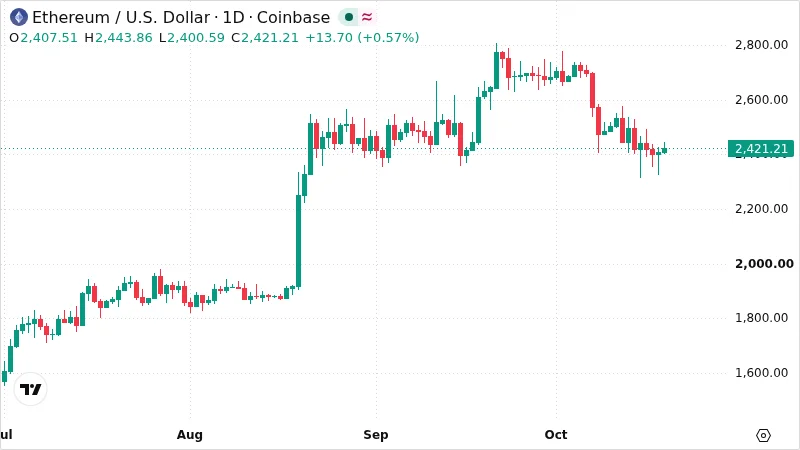
This contrast between robust DeFi activity and subdued ETH price movement suggests that institutional adoption may be decoupling from speculative retail flows. While banks like JPMorgan are integrating with public blockchains for efficiency gains and new settlement models, it’s unclear whether these moves will directly fuel new highs for ETH itself or simply reinforce its role as critical infrastructure beneath regulated finance.
For now, only approved institutions will be able to access these new rails—a reminder that even as blockchain technology enters mainstream banking workflows, core elements of permissioned finance remain firmly in place.
What remains in focus
If JPMorgan’s JPM Coin becomes available for institutional clients on Ethereum as reported, immediate attention will center on whether approved participants begin using the token for peer-to-peer transfers and settlements within the Ethereum ecosystem; the scale and speed of such adoption remain unclear.