
Six Million Bitcoin in the Crosshairs
Roughly 6.4 million bitcoin—about 30% of all coins in existence—have public keys that are already exposed, leaving them especially vulnerable to future advances in quantum computing.
Richard Carback, CTO of Postquant Labs, has suggested that a quantum machine capable of breaking today’s encryption could appear as soon as 2028—a date that now feels uncomfortably close for many holders.
Despite the urgency, it’s important to note that no quantum computer today comes close to this capability. Google’s Willow chip, for example, boasts only 105 qubits, while breaking Bitcoin’s elliptic curve cryptography would require under 500,000 physical qubits by recent estimates. The threat is theoretical for now but rapidly moving toward practicality.
A March 2026 Google whitepaper estimated that breaking Bitcoin’s cryptography would require fewer than 500,000 physical qubits.
Quantum Alliance Unites Crypto Rivals
On Thursday, nine crypto firms—including Quantus and The Vault—announced the formation of the Quantum Alliance to develop shared security standards across major blockchains such as Bitcoin and Ethereum. This collective effort aims to address not just technical hurdles but also the coordination challenges inherent in migrating global networks to post-quantum cryptography.
Coinbase has also stepped into the fray: in July, it joined forces with BlackRock and Strategy to form the Bitcoin Security Consortium, pledging $15 million specifically toward quantum-proofing efforts. Coinbase claims it holds about 5% of all existing bitcoin in custody and has convened a quantum advisory board since January to guide its response.
Such alliances mark a rare moment of unity in an industry often defined by rivalry.
Google’s Leap: Still Miles to Go
Google’s Quantum AI team recently published results showing a dramatic reduction—about fortyfold—in certain quantum errors using a technique called “magic state cultivation.” This breakthrough achieved a record 99.99% fidelity for filtered quantum states on its Willow processor. However, only 8% of attempts passed every check during testing; the vast majority were discarded due to errors.
Despite this progress, the gap remains wide: breaking RSA-2048 encryption (used widely outside crypto) requires error rates around one in ten billion—roughly a million times cleaner than what Google demonstrated. Furthermore, while earlier estimates pegged the need at 20 million qubits to break strong encryption schemes, new research suggests under one million noisy qubits might suffice for RSA and fewer than 500,000 for Bitcoin’s elliptic curve algorithm. But with hardware like Willow still at just over a hundred qubits, practical attacks remain out of reach for now.
See Also
Why it Matters: Practical Impact on Holders
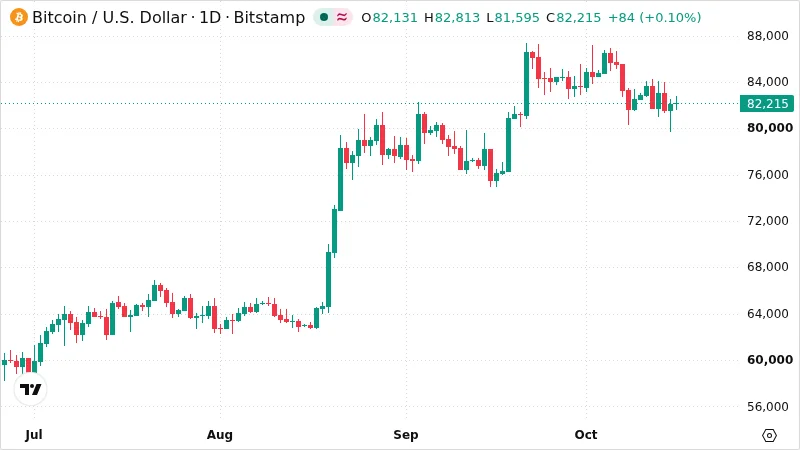
Bitcoin trades today at $82,284—down from its all-time high of $126,080 set in October 2025—but even minor vulnerabilities could have outsized consequences given its $1 trillion-plus market cap and top rank among cryptocurrencies. Should quantum computers become capable of breaking existing cryptography before the network migrates to stronger algorithms, billions in value could be drained from exposed wallets almost overnight.
The transition will not be fast: Coinbase describes it as a complex process likely spanning several years. Their proposal includes staged upgrades such as “1-of-2” constructions (allowing funds to move via either classical or quantum-safe keys) and flexible container designs like BIP-360 so new signature schemes can be swapped in over time without disrupting current operations.
Large Ethereum holders have already been advised by researchers like Justin Drake to shift funds into addresses that have never signed transactions—a move designed to minimize exposure if elliptic curve mathematics are cracked sooner than expected.
Who Moves First: Hackers or Developers?
There is tension between visible progress and underlying risk: Google’s quantum advances are impressive on paper, yet real-word codebreaking remains distant due to hardware limitations and persistent error rates. Meanwhile, some industry voices—including Binance founder Changpeng Zhao and prominent developer Jameson Lopp—have floated controversial ideas like freezing Satoshi Nakamoto's estimated 1.1 million bitcoin or restricting spendability on vulnerable coins should credible threats emerge. These proposals highlight both the stakes involved and the lack of consensus on emergency measures.
While Sui is already piloting quantum-safe transactions on test networks—and Ethereum, Zcash, and Near are planning similar moves—it is unclear how quickly these protections can be standardized across major chains or adopted by everyday users. The timeline may hinge less on technical breakthroughs than on collective action among developers and custodians worldwide.
What to track going forward
If Google or any other actor demonstrates a quantum computer with at least 500,000 physical qubits—below the threshold estimated in a March 2026 whitepaper as needed to break Bitcoin’s elliptic curve cryptography—immediate scrutiny will fall on the 6.4 million bitcoin with exposed public keys, though no such machine exists yet and timelines remain unconfirmed.