
What Our Earlier Coverage Said
On July 15, 2026, our earlier coverage reported that Bitcoin surged to $65,200 after June’s U.S. inflation data came in softer than expected, before settling near $64,800. The article highlighted a brief rally—3% in 24 hours—driven by headline CPI falling 0.4% and core CPI staying flat, which led traders to sharply reduce their bets on a Federal Reserve rate hike that month. Ether was also noted for outperforming Bitcoin during this window, climbing nearly 5% to reach $1,895.
Why This Moment Mattered
At the time, the market was focused on whether cooling inflation would prompt the Federal Reserve to pause or even reverse its tightening cycle. The June CPI report showed both headline and core inflation coming in below expectations: headline CPI dropped by 0.4% (vs. a forecasted 0.1% decresae), and core CPI was flat rather than rising 0.2%. This triggered immediate optimism across risk assets, as reflected in Bitcoin’s quick jump to $65,200 and Ether’s even sharper gains.
The shift in expectations was dramatic: Polymarket odds of a Fed rate hike collapsed from 34% before the data to just 6.7% after; CME’s FedWatch tool echoed this with only a 14.4% chance of an increase based on futures prices. Bond yields fell in tandem—the U.S. two-year Treasury yield dropped seven basis points to 4.19%, while the ten-year slipped five basis points to 4.56%. These moves signaled that traders believed the Fed would hold rates steady, reducing the opportunity cost of holding non-yielding assets like Bitcoin.
This confluence of factors—softer inflation, falling yields, and evaporating rate hike bets—created a textbook setup for risk assets to rally. Yet even as initial enthusiasm pushed Bitcoin higher, momentum faded quickly; by the end of that trading day and into the next, BTC consolidated around $64,800 with $31 billion in volume changing hands. The market seemed caught between relief at lower inflation and uncertainty about what would come next from policymakers.
Where We Are Now: Price and Performance
As of October 11, 2026, Bitcoin trades at $83,063 with no change over the last 24 hours and a negligible -0.03% move over seven days. Over the past thirty days, BTC is up just +0.08%. Notably, Bitcoin remains well below its all-time high of $126,080 set on October 6, 2025—a level it has not revisited since.
Bitcoin holds its market cap rank at #1 but has shown little recent momentum.
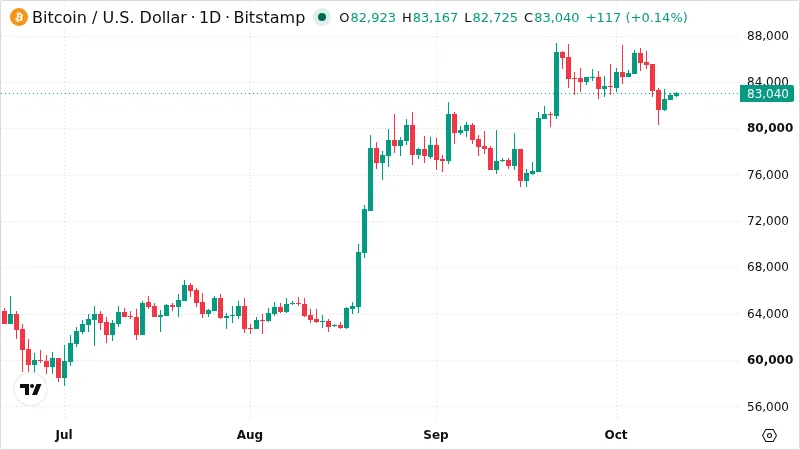
The numbers tell a clear story: despite the optimism following June’s inflation surprise three months ago, Bitcoin has been largely rangebound since then. Its current price is about $18,000 higher than it was during the July rally described in our earlier coverage ($65,200 peak), but this increase unfolded over months rather than days or weeks—and pales compared to its previous run-up toward last year’s record high.
Short-term volatility has evaporated; BTC’s price is almost unchanged over both one week (-0.03%) and one month (+0.08%). This lack of movement suggests that whatever tailwinds emerged from June’s inflation data have since dissipated or been absorbed by broader market forces.
See Also
What These Numbers Actually Mean
The current data shows that Bitcoin never broke out into a sustained rally following July’s post-inflation optimism—it remains far below its October 2025 all-time high of $126,080 and has barely moved in recent weeks or months. While it is true that BTC is higher today than during the specific July event ($65,200), this growth has been slow and uneven rather than explosive or persistent.
BTC’s seven-day change (-0.03%) and thirty-day change (+0.08%) are effectively flatlines for an asset known for volatility—suggesting that neither macroeconomic relief nor any other catalyst has sparked renewed buying interest among investors recently. The fact that BTC still ranks #1 by market cap underscores its dominance but does not indicate fresh enthusiasm or inflows since July.
In practical terms: whatever momentum existed around softer inflation numbers was short-lived and did not translate into lasting price appreciation through October.
Zooming Out: Broader Market Perspective
This episode highlights how sensitive crypto markets can be to macroeconomic headlines—but also how fleeting those reactions often are. In July 2026, traders responded instantly to better-than-expected CPI figures and collapsing Fed hike odds by bidding up Bitcoin and Ether; yet within hours BTC’s momentum faded as markets digested the news more soberly.
The subsequent months have seen Bitcoin stabilize at elevated levels compared to its July price but fail to approach its prior peak from October 2025 ($126,080). This pattern mirrors dynamics seen in other risk asset classes—where short-term rallies on economic data are often reined in by broader structural forces like liquidity conditions or shifting investor sentiment.
For crypto specifically, this underlines a recurring theme: while digital assets can react sharply to macro events (such as inflation surprises or central bank policy shifts), these moves rarely persist unless reinforced by sustained changes in fundamentals or capital flows. The flat performance over both seven days (-0.03%) and thirty days (+0.08%) suggests that after initial excitement fades, participants often revert to wait-and-see mode until new information emerges.
The Verdict: Did Inflation Relief Spark a Lasting Rally?
Looking back at our earlier coverage from July 2026, it is clear that while softer-than-expected inflation briefly lifted Bitcoin (and Ether), this did not translate into a durable uptrend for BTC through October. The current price of $83,063 represents only gradual progress from July’s highs—and remains well below last year’s record level of $126,080.
Recent trading shows almost no movement (+0.08% over thirty days), indicating that any impact from June’s CPI shock has long since faded from markets’ collective memory. The scenario anticipated—a risk asset rally fueled by cooling inflation and dovish Fed expectations—did not play out in any lasting way for Bitcoin.
: while there was an immediate reaction to macro relief in mid-July 2026, it proved transitory rather than transformative for crypto prices through October.