
Finality Now in a Flash
On Wednesday, Solana activated its largest consensus overhaul since 2020, rolling out the Alpenglow upgrade and dramatically cutting transaction finality times. Where users previously waited around 12.8 seconds for transactions to be considered irreversible, the new system aims to cement them in just 150 milliseconds—a reduction of over 99%. This leap means that Solana now offers one of the fastest settlement speeds among major blockchains, as Ethereum’s finality remains at roughly 13 minutes.
Alpenglow achieves this by shifting validator voting off-chain and introducing a certificate-based approach. Instead of each validator submitting votes on-chain for every block, votes are bundled into certificates and sent off-chain, then submitted together. This not only accelerates the process but also reduces network congestion and cost. The upgrade was implemented by Anza and replaces the previous TowerBFT consensus mechanism with a streamlined protocol that condenses Solana’s two-step finality into a single phase.
At slot 459,653,000—around 14:00 UTC—validators officially retired TowerBFT and began using Alpenglow on mainnet.
According to coindesk.com, validators retired TowerBFT at slot 459,653,000—around 14:00 UTC—marking the official start of Alpenglow on mainnet.
Validators Face Cheaper, Simpler Admission
The technical shift is matched by a significant change in validator economics. Previously, validators paid about 2 SOL per day in vote fees—a cost that doubled after slot times were halved to 200 milliseconds in August. With Alpenglow, these recurring vote fees are replaced with an “admission ticket” set at just 0.8 SOL per epoch (roughly every 24 hours), offering a cost reduction of approximately 60% for operators.
This adjustment is not only about saving money; it also simplifies participation for smaller validators who may have struggled with rising operational costs. The move could broaden the diversity of the validator set and strengthen decentralization over time.
For many node operators, this is more than just a technical update—it changes their bottom line overnight.
See Also
Testnet Turbulence Before the Launch
Alpenglow’s path to mainnet was far from smooth. Since early May, Solana’s test network was wiped and restarted six times as developers ironed out bugs and stress-tested the migration process. At least one failed migration required a rollback before stability was achieved. Roughly 100 validator operators—including Galaxy Digital—participated in these public tests, which included red teaming exercises and security competitions.
The upgrade design itself was published in May 2025 by Anza’s research team led by ETH Zurich professor Roger Wattenhofer. Validators approved the change in September 2025 with an overwhelming majority—98% voted for SIMD-0236—demonstrating strong community buy-in despite earlier testnet setbacks.
Mainnet Hits Record-Speed Confirmations
With Alpenglow live as of October 21, Solana’s mainnet dashboard now shows transaction finality at around 6.6 seconds and throughput exceeding 4,700 transactions per second. The target remains an average finality time of just 150 milliseconds as the network stabilizes under real-world load.
That headline speed sets Solana apart from most rivals—but it comes after months of technical turbulence and persistent questions about reliability during high demand periods.
Why This Upgrade Matters Most
From an asset perspective, SOL trades at $108.34 today, a modest +0.03% change over both the past day and week despite this major technical milestone. Over the last month SOL has slipped -0.09%, while its all-time high remains $293.31 (reached January 19, 2025). The market cap rank stands at seventh among cryptocurrencies as of October 21, suggesting that even dramatic improvements in speed do not automatically drive price surges—especially when broader sentiment is cautious or sideways.
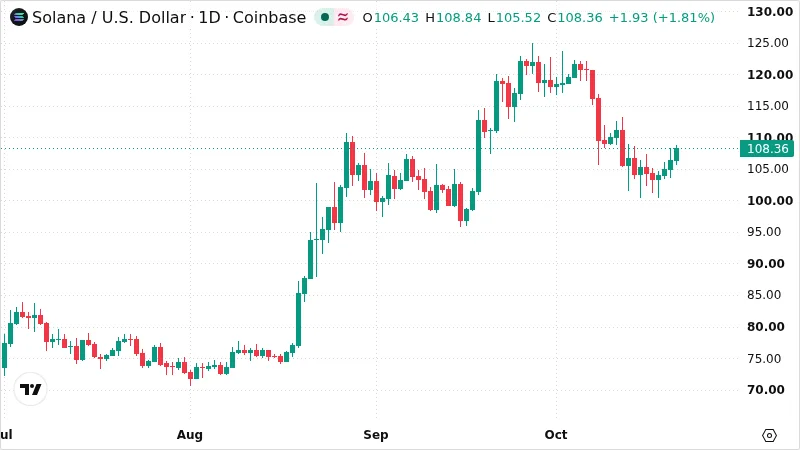
There’s a tension here: Solana now boasts industry-leading finality times yet its token price has barely budged this week—a reminder that technical progress does not always translate into immediate market momentum.
Looking ahead, Alpenglow’s second phase (Rotor) will introduce a new block data distribution protocol intended to replace Turbine; however, no timeline has been confirmed for this next step. For now, Solana’s focus is on monitoring mainnet stability under Alpenglow and ensuring that the promised speed gains hold up during periods of peak activity.
What remains unresolved
It remains unclear whether Solana’s mainnet will consistently achieve the targeted 150-millisecond transaction finality following the Alpenglow upgrade that went live on Wednesday, as the Alpenglow dashboard still showed a 6.6-second finality at press time; if the network fails to reach the promised speed, immediate questions about the upgrade’s effectiveness and validator performance will arise.