New Format Powers Larger, Smarter Trades
Solana has rolled out a mainnet upgrade that more than triples the amount of data allowed in each transaction, marking a significant technical shift for the blockchain.
With this upgrade activated at the start of epoch 1,035, Solana aims to address a longstanding bottleneck that limited on-chain activity. The expanded transaction size opens doors for more complex trades and enables company-wallet approvals that require richer data payloads. According to coindesk.com, this move narrows the gap with Ethereum, which doesn’t enforce a fixed transaction size but instead uses a flexible block gas limit—meaning Ethereum users have long enjoyed more leeway for sophisticated operations.
Apps Scramble to Support V1 Transactions
The transition to Transaction V1 is not just a technical milestone; it also puts pressure on developers and service providers across the Solana ecosystem. Apps and services that read or process Solana data must now recognize the new format or risk failing to handle user requests correctly. This includes wallets, trading platforms, and analytics tools—any service that interacts with raw blockchain transactions.
For some providers, adapting quickly is crucial to avoid disruptions as users begin submitting larger transactions.
Protocols looking to benefit from the increased transaction size must actively upgrade their systems. While legacy transactions remain valid thanks to backward compatibility, only those adopting V1 will see practical improvements in throughput and functionality. This creates a temporary landscape where both old and new formats coexist, but with clear incentives for rapid migration.
See Also
Privacy Features Now Within Solana’s Reach
The ability to pack up to 4,096 bytes into a single transaction is not just about bigger trades—it also paves the way for advanced privacy features. Previously, Solana’s smaller limit made it challenging to implement zero-knowledge proofs and similar cryptographic techniques directly on-chain. With the new ceiling in place as of September 2026, developers can now experiment with these privacy-preserving applications natively.
It’s uncertain how quickly privacy protocols will emerge or gain adoption on Solana; however, the technical barrier has been significantly lowered by this upgrade. attract projects that were previously constrained by data limits or forced to build off-chain solutions.
Why It Matters: Bottlenecks and Market Context
Solana’s changes arrive during an active period for network upgrades. In August, validators agreed to reduce slot time—the interval between blocks—from 400 milliseconds to 350 milliseconds. The Foundation also outlined plans earlier in June to further cut slot times down to 200 milliseconds in future updates. These efforts all point toward one goal: improving speed and scalability while reducing friction for developers and users alike.
Yet there’s nuance beneath these headline improvements. While Solana is technically closing ground with Ethereum on transaction flexibility, Ethereum’s approach remains fundamentally different due to its block gas model rather than a raw byte cap per transaction. As such, some structural differences persist even after this upgrade.
SOL Price Holds Steady Amid Upgrades
Despite these ambitious technical changes, SOL—the native token of Solana—has shown limited price movement in recent weeks. As of September 15th, 2026, SOL trades at $99.5 with a negligible 24-hour change of -0.02% and only +0.31% over the last month. The token remains well below its all-time high of $293.31 set back in January 2025 but continues to hold its place as the seventh-largest crypto by market capitalization.
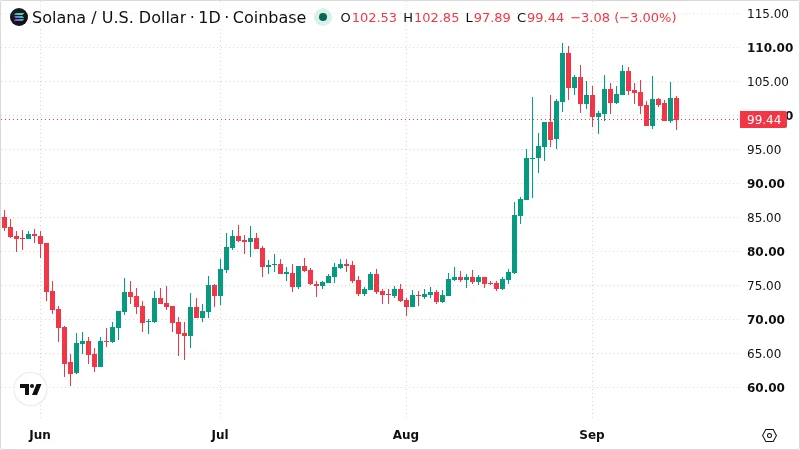
This muted reaction suggests that while infrastructure upgrades are essential for long-term growth and developer adoption, they do not always translate into immediate market enthusiasm—especially when broader crypto sentiment is cautious or when investors await evidence of increased on-chain activity following such changes.
What could influence sentiment
If major apps and services that feed Solana blockchain data to wallets, trading apps, and analytics platforms fail to support the new Transaction V1 format, which went live on mainnet Tuesday at approximately 01:00 UTC, requests for individual transactions can immediately fail.