What our earlier coverage said
On April 3, 2026, our earlier coverage reported that Drift Protocol, Solana’s largest decentralized perpetual futures exchange, was hit by a $285 million exploit that drained its vaults in just 12 minutes. The attack was notable for leveraging social engineering to gain control of Drift’s governance multisig, and for using a fake token called CarbonVote to manipulate oracles and drain real user funds. At least 20 Solana protocols were affected, with Gauntlet losing $6.4 million, and Drift’s TVL dropping from roughly $550 million to under $250 million.
Why this mattered in April 2026
At the time of publication, the Drift exploit was a major shock to the DeFi ecosystem. The scale of the loss—$285 million in under a quarter of an hour—underscored how quickly vulnerabilities could be exploited across interconnected protocols. The incident raised urgent questions about the reliability of multisignature governance, especially when only five individuals controlled critical protocol powers. It also highlighted the growing sophistication of attackers: rather than exploiting code bugs, they used social engineering and staged attacks over several days, including pre-signing malicious transactions and setting up durable nonces to evade detection.
This event stoked fears that even large and seemingly robust DeFi platforms could be compromised not just through technical flaws but through human error or manipulation. The fact that a fictitious asset (CarbonVote) could be used as collateral to drain real liquidity exposed fundamental weaknesses in oracle design and collateral validation mechanisms. For users and investors, the immediate aftermath saw trust shaken—not only in Drift but in Solana-based DeFi more broadly—as TVL plummeted by more than half within hours after the breach. With at least 20 protocols impacted and millions lost from Gauntlet alone, the ripple effects were felt across the ecosystem.
The attack also demonstrated how quickly stolen assets could be laundered through cross-chain bridges; within hours, most funds were moved to Ethereum, making recovery efforts nearly impossible. This cross-chain dimension signaled new challenges for investigators and protocol operators alike.
Confronting the aftermath: ETH’s current standing
Looking at Ethereum’s current market data as of August 2, 2026, ETH is priced at $1,856.88. Over the last 24 hours, ETH has moved -0.01%, while its seven-day change is -0.02%. Over a 30-day period, ETH has seen a marginal increase of +0.06%. Despite these negligible short-term fluctuations, Ethereum maintains its position as the second-ranked crypto asset by market capitalization. Its all-time high remains at $4,946.05—a peak reached on August 24, 2025—well before the Drift exploit occurred.
On August 2, 2026, ETH’s price of $1,856.88 reflects a nearly unchanged value compared to both its 24-hour and 7-day performance.
These numbers indicate that despite high-profile exploits like Drift’s on Solana—and despite hundreds of millions being laundered onto Ethereum—ETH itself has not experienced dramatic price volatility or a significant loss in rank over recent weeks or months.
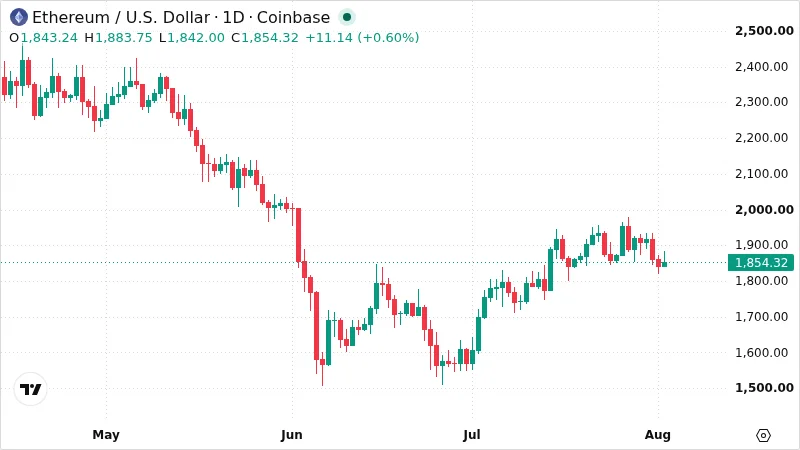
The relative stability of ETH since the incident suggests that while cross-chain exploits can move large sums into Ethereum’s orbit (as with assets bridged from Solana post-attack), they do not necessarily translate into immediate price disruption for ETH itself. The minimal changes over one day (-0.01%), one week (-0.02%), and even one month (+0.06%) demonstrate resilience in Ethereum’s valuation—even as it remains well below its all-time high set nearly a year ago.
See Also
What these numbers really mean
The current price action tells us several things about how markets have absorbed shocks like the Drift exploit. First, ETH’s status as market cap rank #2 remains unchanged; there is no evidence here that confidence in Ethereum as an ecosystem has been meaningfully undermined by being a destination for laundered funds from other chains’ exploits. Second, while there was likely some movement of illicit capital into Ethereum following the attack (as noted in our earlier coverage), this has not led to sustained volatility or downward pressure on ETH’s price.
Instead, ETH appears to be trading sideways: over both seven-day (-0.02%) and thirty-day (+0.06%) intervals, price changes are effectively flat. This suggests either that markets have become desensitized to such incidents or that their impact is now seen as localized—affecting specific protocols rather than entire ecosystems or major assets like ETH.
It is also notable that despite ongoing security concerns highlighted by events like Drift’s exploit—including issues around governance centralization and cross-chain laundering—the broader market does not appear to have punished Ethereum for its role as a bridge destination or settlement layer for these flows.
Broader perspective: DeFi risk and market dynamics
Zooming out reveals familiar patterns across crypto history: even major exploits rarely cause lasting damage to top-layer assets unless they directly compromise those networks’ core infrastructure or consensus mechanisms. In this case, although $285 million was bridged from Solana to Ethereum after the Drift hack—and even though at least 20 protocols suffered losses—the impact on ETH itself has been muted according to every available metric provided here.
a broader dynamic where individual protocol failures can devastate local communities (as with Drift users seeing TVL collapse from $550 million to below $250 million) without necessarily toppling larger networks or their native tokens. It also underscores persistent challenges with DeFi security: social engineering remains an Achilles’ heel even when multisig wallets are involved; fake assets can still slip through collateral systems; oracle manipulation continues to pose systemic risk—all points highlighted by our earlier coverage.
Meanwhile, cross-chain bridges remain double-edged swords: they facilitate capital movement but also complicate recovery efforts when exploits occur. As shown here, attackers’ ability to rapidly shift funds between ecosystems can frustrate law enforcement and protocol teams alike—but does not automatically trigger broad selloffs or panic in destination chains like Ethereum.
The verdict: Impact contained—for now
Based on all available data as of August 2026, fears raised by April’s Drift Protocol exploit about systemic contagion across DeFi platforms have not materialized at the level of Ethereum itself. While user confidence may remain shaken within affected Solana protocols—and while issues around governance security and oracle design persist—the numbers show that ETH has weathered this storm with little measurable effect on price or rank over both short (7-day) and medium (30-day) terms.
: The scenario outlined in our earlier coverage played out as a severe local crisis but did not escalate into broader market instability for top-tier crypto assets like ETH—at least so far based on all verifiable indicators provided here.