
What our earlier coverage said
In April 2026, our earlier coverage highlighted a surge in Bitcoin’s price to $69,350 as news broke of possible US-Iran ceasefire talks and shifting rhetoric from President Trump. The article described how this diplomatic momentum, combined with a wave of short liquidations, pushed BTC to its highest point in over a week and drove total crypto market capitalization above $2.5 trillion. Ether, Solana, XRP, and Dogecoin also posted notable daily gains during this period.
Why it mattered at the time
The spring 2026 rally came amid significant geopolitical uncertainty, with the Middle East conflict driving both oil prices and market anxiety. The excerpt makes clear that traders were closely watching diplomatic developments: reports of a potential “Islamabad Accord” between the US and Iran—brokered by Pakistan—saw Polymarket odds for a ceasefire that month jump from 18% to around 30%. These shifting probabilities fed directly into price action, as seen in the sharp move up for Bitcoin and other major cryptocurrencies.
Short squeezes added fuel to the fire. Over $200 million in crypto short positions were liquidated within 24 hours, dwarfing long liquidations by a factor of four according to CoinGlass data cited at the time. The largest single liquidation involved a $10.17 million ETH-USDT short on Binance. This rapid unwinding punished bearish bets and helped drive an upswing across digital assets, with Bitcoin reclaiming levels above $69,000 and Ether gaining 3.7% in a single day.
The political context was equally important: then-President Donald Trump’s public statements injected further volatility. His threat that Iran could be “living in Hell” if it failed to open the Strait of Hormuz—and his shifting deadlines—kept markets on edge. The excerpt notes that Trump first set a ten-day negotiation window before moving his deadline up to Tuesday, creating additional uncertainty around both oil flows and broader market stability.
How does that moment look now?
Fast forward to August 30, 2026: Bitcoin is trading at $78,511. This marks an increase from the $69,350 level reported during the April ceasefire rally but is far below its all-time high of $126,080 reached on October 6, 2025. Over the past 24 hours, BTC has barely moved (+0.01%), and its performance over the last seven days (+0.02%) and thirty days (+0.22%) shows minimal momentum.
Despite holding onto gains since early April, Bitcoin’s recent price action has been flat.
BTC has now spent nearly five months trading below the $80,000 threshold since peaking last October.
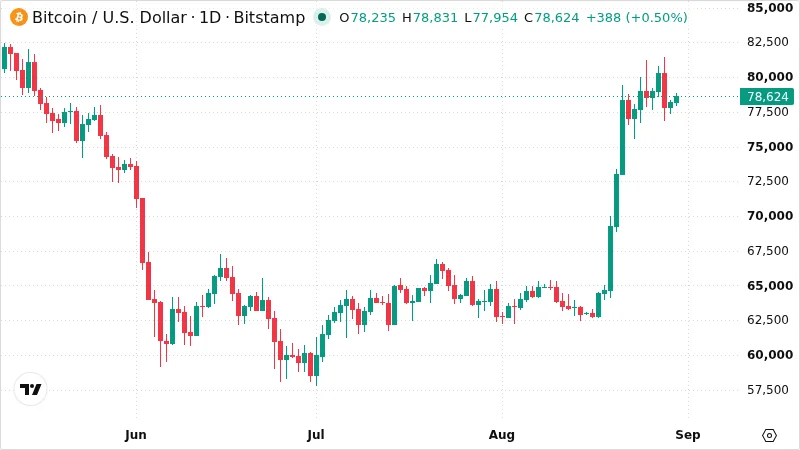
The numbers tell a clear story: while BTC did not lose ground compared to its level during the “ceasefire rally,” it has also not returned anywhere close to its late 2025 peak. The current price suggests a market that is stable but lacking significant new catalysts or volatility in recent weeks. The fact that Bitcoin remains ranked number one by market cap indicates continued dominance within digital assets but does not reflect any fresh surge or collapse since April’s geopolitical-driven spike.
See Also
Parsing expectations versus reality
Looking back at the expectations set in April 2026, there was an implicit sense that major geopolitical events could drive sustained moves in crypto markets—not just quick rallies or squeezes. The excerpt highlighted how quickly sentiment could shift when headlines hit: Polymarket odds for a ceasefire jumped by over ten percentage points within hours; more than $270 million in shorts were wiped out as prices climbed sharply; and altcoins rallied alongside Bitcoin as traders responded to every new development out of Washington or Tehran.
However, current market data points to a different reality. While BTC held onto most of its war-rally gains (from $69,350 to $78,511), it has not experienced any meaningful appreciation since then—just marginal increases over one week (+0.02%) or one month (+0.22%). This flatlining suggests that whatever momentum was generated by April’s headlines did not translate into ongoing bullishness or sustained volatility through late summer.
It is that nothing in the provided data confirms whether the Islamabad Accord was ever finalized or if Trump’s threats led to any lasting resolution—this can’t be confirmed yet based on available information.
Broader perspective: Crypto’s reaction function
The episode illustrates how quickly crypto markets can respond to external shocks—especially those tied to geopolitics—but also how fleeting those reactions can be once news flow slows down. In April 2026, traders reacted almost instantly to diplomatic signals between the US and Iran; Polymarket odds shifted by double digits within hours; hundreds of millions in shorts were liquidated; and major tokens posted daily gains between 1.7% and 3.7%. Yet four months later, with BTC up only modestly from those levels and showing almost no movement over days or weeks, it becomes clear that such rallies are often short-lived unless reinforced by further developments.
This pattern echoes previous instances where war scares or macro headlines prompted sudden surges in digital asset prices—only for those moves to fade as uncertainty resolved or new narratives took center stage.
Bitcoin’s all-time high of $126,080 (October 2025) now looks like an outlier rather than a baseline for future growth—at least for this current cycle. With BTC still ranked number one by market cap but unable to break out of its current range since April’s rally ($69,350 up to $78,511), investors may be recalibrating their assumptions about how much impact geopolitics can have on long-term crypto valuations versus short-term trading opportunities.
The verdict: Did the scenario play out?
Based on current data as of August 30, 2026, the war-driven rally described in our earlier coverage did lead to higher prices for Bitcoin relative to early April—but not by much (from $69,350 then to $78,511 now). The immediate surge proved durable enough for BTC to avoid retracing those gains but failed to spark any lasting upward trend toward previous highs like October’s $126,080 peak.
: The scenario played out as a brief momentum burst rather than a transformative event for crypto markets. Headlines moved prices quickly in April; since then, stability has prevailed rather than sustained exuberance or collapse.