
Bitcoin shrugs off inflation jitters
Bitcoin’s price action has remained notably subdued in the face of rising U.S. inflation concerns and looming Federal Reserve rate hike expectations. As of November 11, 2026, Bitcoin is trading at $73,497, reflecting a negligible 24-hour change of -0.01% and a seven-day dip of just -0.06%. Despite market anticipation around the latest Consumer Price Index (CPI) report, the world’s largest cryptocurrency has barely budged, even as ETF (exchange-traded fund) selling—previously a significant headwind—has started to slow.
This muted response stands in contrast to the broader financial markets, where U.S. equities have staged rebounds on multiple occasions over the past week. While stocks bounced back on Monday, Bitcoin slipped instead, showing little correlation with traditional risk assets during this period.
According to coindesk.com, Tuesday’s hotter-than-expected inflation data pushed the probability of a U.S. interest-rate increase to approximately 90%. Yet, Bitcoin’s price reaction was minimal—a sign that either sellers are exhausted or that traders are waiting for clearer signals before making their next move.
Spot Bitcoin ETFs lost $201 million in outflows ahead of the October inflation report.
ETF outflows weigh on price
ETF flows have been a focal point for crypto investors throughout 2026. Spot Bitcoin ETFs experienced $201 million in outflows ahead of the latest inflation report, marking the fourth consecutive day of net withdrawals. This pattern has persisted even as ETF selling activity began to cool in recent sessions. The ongoing outflows have coincided with increased liquidations across leveraged positions, amplifying short-term price pressures.
ETF exits have not triggered panic selling but have certainly capped any meaningful upside for now.
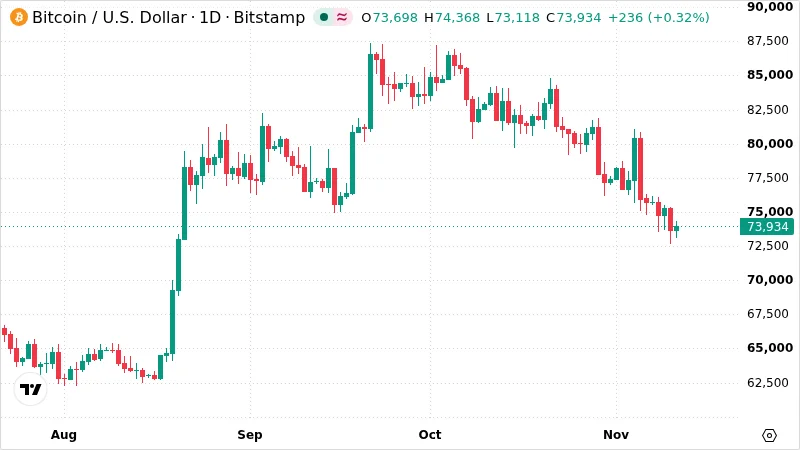
Despite these persistent outflows, Bitcoin has managed to hold near $74,000 for much of the week—an area that has acted as a psychological anchor since late October. The resilience is notable given that its all-time high was set at $126,080 just over a year ago (October 2025), underscoring the scale of the current retracement and the market’s ability to absorb ETF-driven selling without cascading losses.
Rate hike odds climb to 90%
The CPI release on Tuesday not only reignited inflation fears but also sharply increased expectations for another Fed rate hike before year-end. Traders are now pricing in a 90% chance of an interest-rate increase—a significant shift that has not gone unnoticed by crypto market participants. Fed Governor Waller’s comments supporting December tightening added further weight to these expectations, even as falling oil prices offered some relief on the inflation front.
Yet here lies a contradiction: while macroeconomic signals point toward tighter monetary policy and higher borrowing costs—a scenario typically bearish for risk assets—Bitcoin’s price has barely moved over the past month (-0.11%). Investors might be bracing for volatility, but so far there’s little evidence of aggressive repositioning in spot markets.
See Also
Crypto lagging stock market bounce
A micro-contrast has emerged between Bitcoin and U.S. equities: while stocks rebounded earlier this week after previous declines, Bitcoin failed to follow suit and instead slipped ahead of key economic data releases. This divergence suggests that crypto traders may be more focused on ETF flows and central bank policy than on broader risk sentiment for now.
With market cap rank holding steady at number one and daily price swings narrowing, it remains uncertain whether Bitcoin will break from its current range before year-end or continue to lag behind equity rallies as monetary policy uncertainty persists.
Key signals ahead
If October inflation data released later today comes in above expectations, with traders already pricing in a roughly 90% chance of a U.S. interest-rate increase, immediate further ETF outflows and heightened liquidations could follow; however, the exact scale of these reactions remains unclear.