
Seven Days of BlackRock Withdrawals
Over the past week, the U.S. spot Bitcoin ETF market has experienced an unrelenting wave of outflows, with BlackRock’s iShares Bitcoin Trust (IBIT) leading the exodus. IBIT has now posted seven consecutive days of withdrawals, losing a total of $1.66 billion since October 30. On Monday alone, IBIT saw $213 million in outflows, contributing to a broader net withdrawal of $201 million across all U.S. spot Bitcoin ETFs that day. This persistent negative flow marks a sharp reversal from earlier periods in 2024 and 2025, when net inflows into these products reached roughly $25 billion by early November each year.
Despite this mass movement out of major funds, not every ETF mirrored the trend: Morgan Stanley’s Bitcoin Trust ETF (MSBT) recorded $22 million in inflows on the same Monday, highlighting that investor sentiment remains divided even as headline numbers point to widespread withdrawals.
The Crypto Fear & Greed Index ticked up slightly to 32 on Monday—still deep in “fear” territory but up from 26 a week ago—suggesting that while nerves are frayed, some traders may be looking for opportunistic entry points amid the sell-off.
ETF Outflows Shake Bitcoin Bulls
Bitcoin’s price action has reflected these ETF outflows, with the token falling back to $74,000 ahead of key economic data releases. The current BTC price sits at $74,187 as of November 10, 2026—a marginal 0.01% dip over the last 24 hours and a 0.03% slide across the past week. More striking is how far Bitcoin remains from its all-time high of $126,080 set in October 2025; the recent outflow-driven pressure has reinforced a downtrend that’s persisted for months.
Year-to-date net withdrawals from U.S. spot Bitcoin ETFs have reached $1.1 billion, compared to net inflows of $25 billion by early November in both 2024 and 2025.
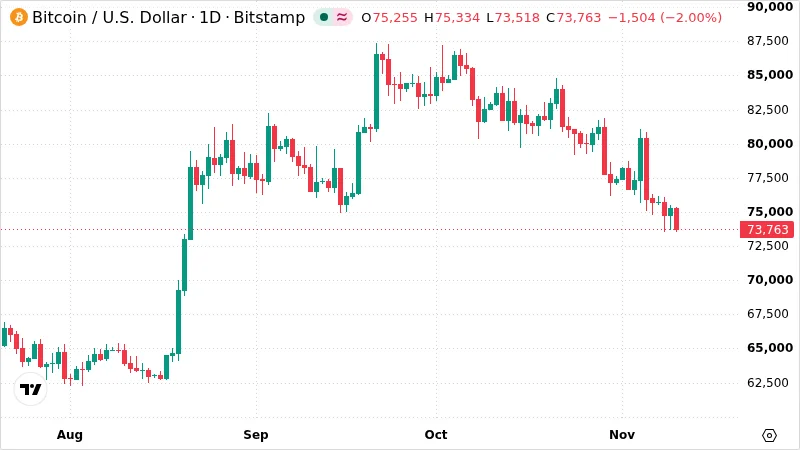
Year-to-date net withdrawals from U.S. spot Bitcoin ETFs have now reached $1.1 billion. This stands in stark contrast to previous years’ surges and underscores how fickle institutional sentiment can be when macroeconomic conditions shift or when risk appetite wanes.
For many market participants who once saw ETF inflows as a reliable bullish catalyst, this reversal is forcing a rethink.
Marathon Digital Pulls Back Holdings
It isn’t just ETF investors who are reducing exposure: Marathon Digital Holdings (MARA), one of the largest publicly traded Bitcoin miners, has also pared back its BTC holdings recently. While details on MARA’s specific sale volumes remain limited, their reduction signals that even industry insiders are taking risk off the table during this period of price stagnation and persistent fund outflows.
This move by MARA adds another layer to the current environment—miners often hold large amounts of Bitcoin on their balance sheets and can act as both stabilizers and sources of selling pressure depending on market conditions.
See Also
Fed Rate Hike Fears Hit Crypto
Broader macroeconomic forces are also weighing on crypto markets. Ahead of this week’s Consumer Price Index (CPI) release, traders have fully priced in another Federal Reserve rate hike. Fed Governor Chris Waller’s suggestion that a 50-basis-point increase could be on the table if inflation persists has only heightened uncertainty across risk assets—including Bitcoin.
This intersection between monetary policy expectations and crypto flows is especially evident now: while stocks have managed to rally in certain sessions, Bitcoin has decoupled from equity markets and moved lower as ETF outflows mount and rate hike fears linger.
Why it matters
The headline number—$1.66 billion in BlackRock ETF withdrawals over seven sessions—looks dramatic, but context complicates any simple interpretation. While institutional selling has clearly pressured prices downward (with BTC down nearly 0.10% over the last month), some funds like MSBT still see inflows and retail sentiment as measured by fear indices is slowly improving from extreme lows.
For everyday investors and industry participants alike, this episode underscores how quickly tides can turn in crypto markets: what was once considered a steady inflow pipeline via ETFs can reverse sharply when macro headwinds or profit-taking emerge. The divergence between ongoing miner sales (like MARA’s) and selective ETF inflows further illustrates that not all segments of the market are moving in lockstep—even during pronounced downturns.
As reported by cointelegraph.com, these developments have left year-to-date net withdrawals at $1.1 billion for U.S. spot Bitcoin ETFs—a figure that may prompt both caution and opportunity-seeking as traders await clarity from upcoming inflation data and central bank decisions.
What Stands Out
- •BlackRock’s iShares Bitcoin Trust (IBIT) saw $1.66 billion in outflows over seven consecutive trading days since October 30.
- •Year-to-date net withdrawals from US spot Bitcoin ETFs reached $1.1 billion, compared to $25 billion net inflows by early November 2024 and 2025.
- •Bitcoin traded at $74,594 on Monday, down 2.8% over seven days and well below its October 2025 all-time high of $126,080.
What to watch closely
If BlackRock’s iShares Bitcoin Trust (IBIT) records an eighth consecutive day of outflows after already seeing $1.66 billion withdrawn since October 30, it would immediately extend the ongoing pressure on Bitcoin price that has accompanied recent ETF outflows and MARA’s reduced holdings; whether this trend continues remains unclear.