
Crypto Selloff Mirrors Broader Market Slump
Bitcoin’s price tumbled below the $80,000–$82,000 range in the last 24 hours, as mounting U.S. inflation concerns and a wave of selling across global markets hit risk assets hard. The flagship cryptocurrency slid more than 2% at one point, with buyers only stepping in just above $80,000 near 02:30 UTC—close to the October 8 low of $80,300. Altcoins fared even worse: ether (ETH) dropped over 6% to around $2,350, while XRP and solana (SOL) each shed roughly 5%, according to coindesk.com.
The selloff was not limited to digital assets. Copper futures extended their losing streak with a nearly 1% dip on Thursday after dropping 1.6% the previous day. Meanwhile, Nasdaq index futures slid about 1%, compounding Wednesday’s 1.9% loss in the Nasdaq Composite. Risk-sensitive currency pairs such as the Aussie dollar-Swiss franc also moved lower as investors dumped positions tied to growth and speculation.
South Korea’s Kospi index plunged 8% and triggered circuit breakers during Thursday’s rout.
The synchronized decline across asset classes signals that crypto remains tightly linked to broader macroeconomic sentiment—especially when inflation or interest rate fears flare up.
Gold Shines as Risk Assets Slide
In stark contrast to crypto and equities, gold prices climbed 1% over the same period. This classic safe haven move suggests that investors are seeking shelter from volatility triggered by fresh inflation data and uncertainty over central bank policy directions. While bitcoin has sometimes been touted as “digital gold,” this week’s action highlights a persistent divergence: gold rallied even as BTC and major altcoins fell sharply.
Gold’s resilience stands out amid the carnage in both stocks and cryptocurrencies.
At the same time, U.S. Treasury yields retreated sharply, with the yield on the benchmark 10-year note falling eight basis points to 5.08%. This drop from a recent peak of 5.36% reflects shifting expectations about Federal Reserve policy—and perhaps some flight-to-quality flows into government bonds as well.
See Also
Buyers Defend $80,000 Bitcoin Floor
Despite the initial plunge below $80,000—the first such breach in a month—bitcoin managed a quick rebound, climbing back to $82,200 within 90 minutes and holding steady there for much of Thursday. This bounce coincided with heavy liquidations: nearly $483 million in bitcoin and ether futures positions were closed out over the past day as leveraged traders scrambled to cover losses. Of that total, ether contracts accounted for about $286 million in liquidations compared to bitcoin’s $197 million.
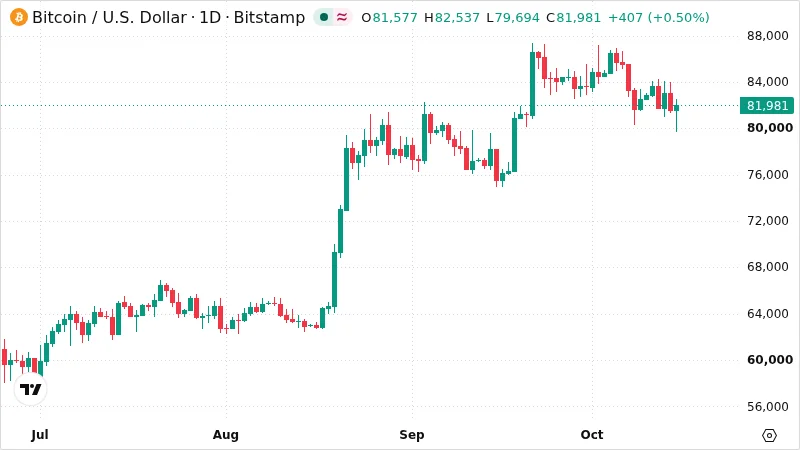
These figures underscore how quickly sentiment can shift when key technical levels are tested—and how automated trading activity can amplify moves in both directions.
Yet while bitcoin recaptured some lost ground after buyers stepped in above $80,000, its recovery was less pronounced than gold’s rally or even the retreat in bond yields.
Altcoins Lead Crypto Downturn
The pain was especially acute for smaller tokens and speculative plays. The CoinDesk Memecoin Index dropped by 4%, with all but six members of the CD100 finishing lower on Thursday. Pump.fun (PUMP), one of the more volatile meme coins, plunged by over 9%. Solana futures saw about $31 million in liquidations as SOL fell roughly 5.5%, while Zcash (ZEC) contracts added nearly $19 million in forced closures after ZEC dropped around 13%.
[p>TWEET]Meanwhile, major indices tracking blue-chip digital assets also slumped: The CoinDesk 80 (CD80) index slid by 2.2%, while the CoinDesk 5 (CD5) lost about 0.7%. These numbers highlight that altcoins bore the brunt of selling pressure during this market rout—outpacing even bitcoin’s losses both in percentage terms and liquidation volumes.
It’s uncertain whether this sharp divergence will persist if macro headwinds remain strong.
Why it matters
Looking at our proprietary data as of October 15, bitcoin is currently priced at $82,231—flat on both a daily and weekly basis but up just 0.07% over the past month. This tepid performance comes despite an all-time high of $126,080 reached on October 6 last year and cements BTC’s status as a bellwether for broader crypto sentiment during periods of stress. With nearly $1 billion in crypto bets liquidated across major tokens like BTC and ETH during Thursday’s slide alone, market participants face heightened risks if volatility persists into upcoming economic releases or Fed meetings.
There is also a notable contrast between investor reactions: while CME fed funds futures now price a nearly one-in-three chance that the Federal Reserve will raise its benchmark rate later this month—with remaining odds favoring no change—bitcoin’s muted rebound suggests traders are cautious about further upside until inflation trends become clearer or risk appetite returns across global markets.
Signals yet to emerge
If the Federal Reserve raises its benchmark rate to the 4%–4.25% range later this month, as CME fed funds futures currently assign a 29% probability, bitcoin and other risk assets could see immediate further volatility; however, confirmation of the Fed's decision remains unclear at this time.