
Short Squeeze Fuels Bitcoin’s Breakout
Bitcoin surged above the $80,000 mark on Friday, climbing nearly 6% over the past 24 hours and reaching an intraday high of $81,055 in New York.
The intensity of this move was underscored by cumulative cross-crypto short liquidations nearing $250 million in just four hours, as reported by market data providers. Bitcoin opened Friday at $76,355 before surging to an intraday high of $80,857, highlighting the speed and scale of the reversal after earlier dips. With the Average Directional Index (ADX) for Bitcoin standing at 40.6—well above the 25 threshold indicating a strong trend—technical momentum added fuel to the rally even as policy uncertainty persisted.
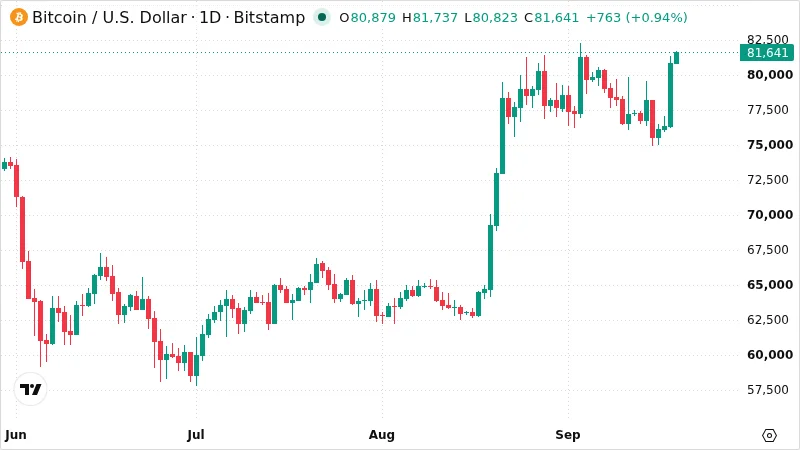
Despite these gains, Bitcoin remains nearly 20% below its all-time high of $126,080 set in October 2025, suggesting that while the current surge is notable, it exists within a broader context of prior volatility and correction.
Clarity Act Failure Fails to Dent Rally
Earlier in the week, lawmakers blocked the Clarity Act—a bill aimed at providing regulatory structure for digital assets—in a Senate procedural vote. The immediate market reaction saw Bitcoin fall below $75,000 following the legislative setback. Yet by Friday, not only had BTC recovered those losses but it also posted fresh seven-month highs. This resilience was mirrored across major tokens: Ether (ETH) rose 7.3%, XRP gained 8.9%, and Solana (SOL) jumped 12.7% to reach $112.
Policy gridlock may have rattled nerves temporarily, but traders quickly shifted focus back to market structure and momentum.
The contrast between negative ETF flows earlier in the week—investors pulled nearly $427 million from U.S.-listed Bitcoin exchange-traded funds—and Thursday’s turnaround with $160 million in net inflows highlights how quickly sentiment can shift despite ongoing legislative ambiguity.
Fed Rate Hike No Deterrent for Bulls
On Wednesday, the Federal Reserve hiked interest rates by 25 basis points—the first such move since 2023—and signaled a median policy rate of 4.1% through late 2027. Typically, higher rates pressure risk assets like cryptocurrencies by making traditional investments more attractive. However, Bitcoin’s price action told a different story: after an initial dip post-announcement, bulls reasserted control and drove prices higher into Friday’s session.
Federal Reserve chair Kevin Warsh emphasized that price stability remains the central bank’s top priority amid persistent inflation concerns. Yet even as monetary tightening continued, crypto-related stocks rallied sharply: Coinbase jumped 11.7%, MicroStrategy soared 16.4%, Gemini advanced 31%, Securitize gained 21.7%, and MARA Holdings climbed 13.7%. This broad-based strength suggests that investors are looking beyond short-term rate moves toward longer-term adoption themes.
See Also
Liquidations Mount as Shorts Get Crushed
The latest surge triggered widespread liquidations across leveraged positions betting against further upside. Over $445 million in shorts were wiped out across crypto markets within a single day, with Bitcoin representing more than half that total at approximately $230 million. Other tokens like Jupiter (JUP), Raydium (RAY), and Meteora (MET) also saw double-digit percentage gains—ranging from roughly 15% to 20%—as bears scrambled to cover positions.
Solana’s rally was especially notable: its price reached $112 for the first time in seven months amid this wave of forced buying activity. Meanwhile, technical signals continued flashing green for Bitcoin: its 50-day exponential moving average (EMA) now sits above its longer-term 200-day EMA—a so-called “golden cross” pattern that entered play last Saturday and is often interpreted as a bullish signal by traders.
Crypto Markets Shake Off Policy Uncertainty
Despite recent turbulence from both Washington and central banks, digital asset markets have demonstrated remarkable resilience heading into late September. As of September 19th, proprietary data shows Bitcoin trading at $81,497 with a negligible change over both daily (+0.01%) and weekly (+0.05%) timeframes—a sign that volatility has compressed even as prices remain elevated near local highs.
Yet this stability comes with nuance: while headline numbers look robust for now, U.S.-listed ETFs only recently returned to positive inflows after two days of withdrawals totaling hundreds of millions of dollars earlier in the week. Investors appear willing to re-engage with crypto exposure despite unresolved questions around regulation and monetary policy—a microcosm of the broader push-pull dynamic defining today’s digital asset landscape.
Key signals ahead
If U.S. Bitcoin ETF flows remain positive after Thursday’s $160 million net inflow, this would immediately signal renewed institutional demand following two days of outflows; however, sustained outflows would indicate continued caution despite Bitcoin’s surge past $80,000.