
What our earlier coverage reported
On August 4, 2026, our earlier coverage detailed a critical security flaw in Coldcard hardware wallets that enabled attackers to steal over $100 million in Bitcoin. The article cited at least 1,596 BTC drained from approximately 7,300 addresses, with a fourth attack wave suspected to have stolen another 449 BTC from 709 addresses—pushing total losses near $130 million at then-current prices. The vulnerability stemmed from outdated firmware that generated wallet seeds with only 40 bits of entropy, making it feasible for attackers to guess private keys and drain single-key wallets.
Why this mattered at the time
The Coldcard exploit was significant because it exposed the vulnerability of hardware wallets—products widely marketed as a gold standard for self-custody security. At the time of publication, Bitcoin traded near $63,800, so each compromised wallet represented a substantial dollar loss for affected users. The scale and speed of the thefts—at least three major attack waves and a possible fourth—raised immediate concerns about the safety of funds stored in hardware wallets and whether other devices might be similarly at risk.
The incident also highlighted how reliance on outdated firmware could undermine even robust security models. According to the excerpt, over 90% of stolen Bitcoin remained unmoved on-chain shortly after the attacks, suggesting that attackers were either waiting out law enforcement or planning their next steps carefully. The fact that at least 15 distinct attackers were identified by Galaxy Digital’s research team added another layer of complexity, indicating a coordinated but fragmented campaign rather than a single perpetrator. This fragmentation made it harder for investigators to track and recover funds, further fueling anxiety among wallet users.
For many in the crypto ecosystem, this event served as a stark reminder that technological weaknesses—even in trusted products—could lead to massive real-world losses. It also forced exchanges and law enforcement agencies to act quickly by flagging both attacker and victim addresses in an attempt to prevent further laundering of stolen assets.
Bitcoin’s current status: price and trajectory
As of September 29, 2026, Bitcoin is trading at $82,932. Over the past week, its price has changed by -0.01%, while the past month shows a modest increase of +0.06%. These numbers indicate that Bitcoin has remained relatively stable recently, with no dramatic swings in either direction over these periods.
Despite the high-profile Coldcard exploit just over a year ago, Bitcoin remains ranked number one by market capitalization.
Bitcoin’s all-time high of $126,080 was set on October 6, 2025, nearly a year before the current $82,932 price point.
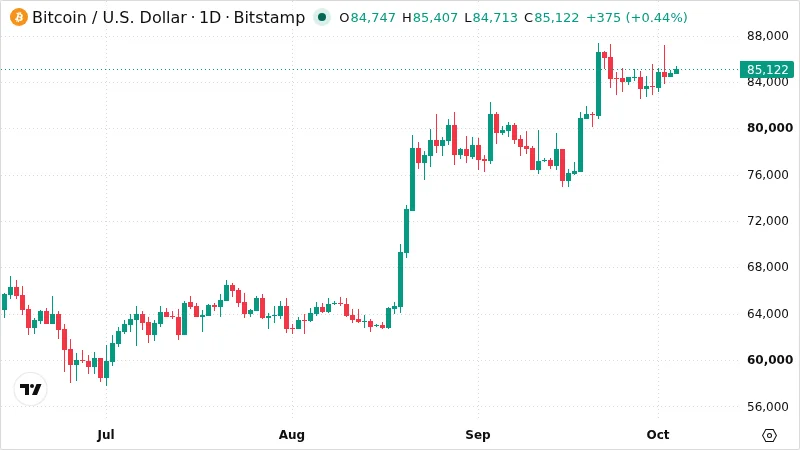
While the current price is significantly higher than during the period covered by our earlier article ($63,800), it is still well below Bitcoin’s all-time high of $126,080 reached on October 6, 2025. This means that although there has been some recovery or growth since last summer’s breach, Bitcoin has not returned to its previous peak levels within this timeframe. The stability seen over recent weeks suggests that any immediate panic or selloff resulting from hardware wallet exploits did not have a lasting impact on overall market confidence or price momentum.
See Also
Comparing expectations with reality
At the time of the Coldcard incident, fears centered on whether such a large-scale exploit would erode trust in self-custody solutions and trigger wider instability across Bitcoin markets. The excerpt from our August 2026 coverage pointed to urgent action from both law enforcement and exchanges as they scrambled to contain fallout and prevent laundering of stolen coins. There was an implicit expectation that if attackers succeeded in cashing out or moving significant amounts of BTC undetected, it could undermine faith not only in hardware wallets but potentially in Bitcoin itself as a secure store of value.
However, present-day market data does not show evidence of long-term damage to Bitcoin’s adoption or investor confidence. The current price is up compared to when the exploit was first reported ($82,932 now versus $63,800 then), despite being well below its all-time high. The minimal changes over the past week (-0.01%) and month (+0.06%) reinforce this sense of resilience: neither renewed panic nor persistent downward momentum appears evident in recent trading activity.
In other words: while individual users suffered real losses due to outdated firmware vulnerabilities—and those losses were significant—the broader market seems to have absorbed this shock without systemic disruption.
Broader perspective: learning from crises
The Coldcard exploit offers a clear example of how technological risks can threaten even established crypto infrastructure—but also how markets can compartmentalize such events when underlying fundamentals remain strong. Even after $100 million-plus was siphoned from thousands of wallets (according to our earlier coverage), Bitcoin retained its top spot by market cap and eventually saw its price climb higher than during the crisis period.
This dynamic echoes previous episodes in crypto history where major hacks or failures (such as exchange breaches) led to short-term volatility but did not permanently derail long-term growth trajectories for leading assets like Bitcoin. The fact that most stolen funds remained unmoved on-chain also raises questions about attacker incentives and law enforcement deterrence—a pattern observed after several prior high-profile heists where moving large amounts risked detection and seizure.
Ultimately, this episode underscores two recurring lessons for crypto participants: first, technical diligence (such as keeping firmware updated) remains essential for individual security; second, even large-scale incidents may not fundamentally alter market structure if confidence in core technology persists.
The verdict: Market resilience trumps individual tragedy
Based on all available data, fears raised during last year’s Coldcard hardware wallet exploit—that such an incident could trigger lasting damage to Bitcoin’s price or reputation—have not materialized at scale. While thousands lost funds due to specific technical flaws (as detailed in our earlier coverage), Bitcoin itself continues to trade well above levels seen during the crisis period and maintains its position as the largest cryptocurrency by market cap. With current price stability and no sign of renewed volatility linked directly to hardware wallet vulnerabilities, it appears that this scenario has largely played out without lasting systemic impact—though individual victims remain affected.