
What Our Earlier Coverage Reported
Our earlier coverage from July 2026 detailed how the U.S. Treasury’s OFAC sanctioned 134 crypto wallet addresses linked to ISIS-K, with Tether freezing $1.4 million across 131 Tron wallets and three Monero addresses also targeted. The article highlighted that $880,000 had already been moved out of these wallets, showing significant activity before authorities intervened. It also noted that while Tether could freeze assets on Tron, privacy coins like Monero presented a new challenge for enforcement.
Why This Mattered at the Time
In mid-2026, the intersection of crypto and illicit finance was under intense scrutiny, especially after authorities identified $1.4 million flowing through Tron wallets tied to ISIS-Khorasan. The fact that $880,000 had already left these wallets before sanctions hit underscored fears about how quickly terrorist groups could exploit fast, low-fee blockchains for cross-border transfers. The inclusion of three Monero addresses in OFAC’s list marked a tactical shift—previously, most sanctioned wallets were on transparent chains like Tron or Bitcoin, but now regulators were signaling a willingness to pursue actors using privacy coins, even if freezing those funds was technically impossible.
The implications were twofold: first, that centralized stablecoin issuers like Tether could act as chokepoints in enforcing international sanctions when wallet addresses are public; second, that privacy coins such as Monero might become more attractive to illicit actors precisely because they are harder to police. This raised questions about how effective such interventions would be in the long run and whether regulatory pressure would push bad actors deeper into less transparent networks or alternative digital assets.
Comparing Then and Now: Current Bitcoin Market Data
Fast forward to September 20, 2026: Bitcoin remains the number one cryptocurrency by market cap. Its current price stands at $80,342. Over the past 24 hours, it has moved just -0.01%, while its seven-day change is +0.05% and its thirty-day change is +0.03%. These numbers reveal a period of remarkable stability for BTC—at least in terms of price movement—despite ongoing regulatory actions and headlines involving crypto’s role in illicit finance.
Bitcoin’s price is still well below its all-time high of $126,080 reached on October 6, 2025.
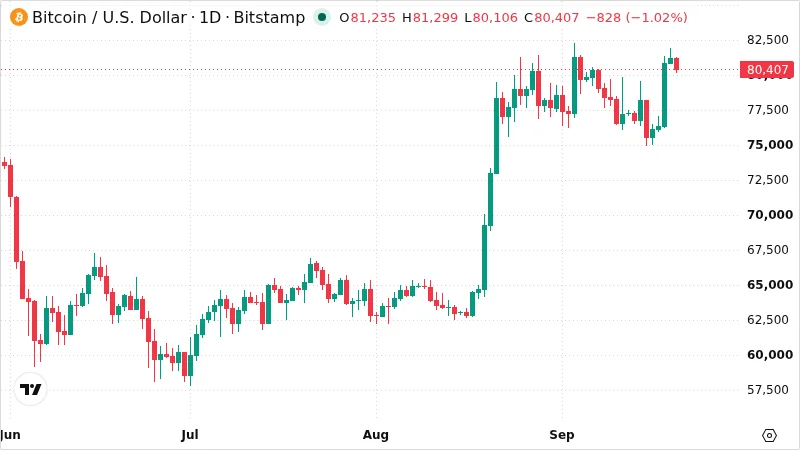
This means that since the time of the OFAC sanctions against ISIS-K wallets in July 2026, there has been no major price disruption or volatility attributed directly to those enforcement actions—at least none visible in Bitcoin’s current pricing data. With a virtually flat performance over both the past week (+0.05%) and month (+0.03%), it is clear that neither panic nor exuberance has gripped BTC holders as a result of these events.
See Also
What These Numbers Actually Imply
The muted movement in Bitcoin’s price since July 2026 suggests that market participants did not view the ISIS-K sanctions as a systemic threat to BTC or the broader crypto ecosystem. Despite ongoing concerns about digital assets being used for illicit finance—as illustrated by OFAC’s targeting of both transparent (Tron) and privacy-focused (Monero) networks—the largest cryptocurrency by market cap has shown little reaction.
This lack of volatility is notable given that regulatory announcements have historically triggered sharp moves in crypto prices. Here, however, BTC’s negligible changes over one day (-0.01%), one week (+0.05%), and one month (+0.03%) indicate either confidence in Bitcoin’s resilience or perhaps market fatigue with repeated enforcement headlines that have not yet resulted in lasting structural change or existential risk for mainstream cryptocurrencies.
Additionally, being ranked number one by market cap as of September 20 reaffirms Bitcoin’s dominance despite these regulatory interventions elsewhere in the sector.
Broader Perspective: Crypto Sanctions and Market Resilience
Looking at the bigger picture, this episode underscores two persistent dynamics within crypto markets: first, that targeted enforcement actions—even those involving terrorism financing—have not meaningfully dented major asset prices when those actions are limited to specific wallets or networks; second, that centralized stablecoin issuers like Tether are increasingly playing a policing role on transparent chains such as Tron but have limited reach over privacy coins like Monero.
The fact that OFAC included Monero addresses for the first time signals an evolution in regulatory tactics—authorities are willing to name and shame even when technical enforcement is impossible at the protocol level. However, as our earlier coverage noted, this does little to stop actual movement of funds on privacy chains: freezing is not possible on Monero itself. The regulatory spotlight may deter some actors but appears not to have disrupted overall confidence in flagship assets like Bitcoin.
In essence, while compliance tools work well where transparency exists (as with Tether on Tron), their effectiveness diminishes sharply on privacy-oriented networks—a dichotomy regulators must continue to navigate.
Moreover, comparing this episode to previous crackdowns—such as earlier Tether freezes totaling $182 million across five Tron wallets—it becomes clear that market structure absorbs such shocks without significant price impact unless enforcement scales up dramatically or targets core infrastructure rather than peripheral actors.
The Verdict: Did Sanctions Move the Needle?
Based strictly on available data—the negligible changes in Bitcoin’s price since July 2026 and its continued number one ranking—it appears that the scenario described in our earlier coverage did not result in any meaningful market disruption for BTC. The intervention succeeded in freezing funds where possible (Tether/Tron), but did not trigger broader selloffs or loss of confidence among mainstream crypto holders.
The fears raised about terrorist groups exploiting fast blockchains remain valid concerns for policymakers and law enforcement but have not translated into visible instability for leading digital assets so far. For now, enforcement actions like those against ISIS-K wallets seem contained within their immediate context—effective at disrupting specific flows but not at shaking the foundations of major cryptocurrencies such as Bitcoin.