
What We Reported in March
On March 16, 2026, our earlier coverage highlighted Bitcoin’s surge past $74,000, reaching $74,500 in U.S. morning trading.
Why That Moment Mattered
At the time, Bitcoin’s move above $74,000 was significant for several reasons outlined in the excerpt. First, it marked a nearly 25% rebound from February’s low of $60,000, signaling renewed bullish momentum after a period of stagnation or decline. The influx of $2.1 billion into spot ETFs over just three weeks suggested rapidly growing institutional interest, with ETF holdings accounting for 6.1% of all bitcoin—a notable shift in market structure that could potentially stabilize or amplify price moves depending on investor behavior.
Geopolitical tensions involving Iran were also front and center: the article tied bitcoin’s ascent to market volatility sparked by Middle East conflict and oil price swings. With crude oil futures briefly topping $100 per barrel before retreating, bitcoin’s resilience above its 50-day moving average ($71,125) was framed as evidence of its emerging role as a “safe haven” asset during periods of global uncertainty—at least relative to traditional commodities like oil. The scale of trading activity was underscored by CoinGlass data showing nearly 92,000 traders liquidated in a single day and $284.9 million in short positions wiped out as bitcoin topped $74,000.
Institutional accumulation was another focal point: the article cited Strategy’s purchase of 22,337 BTC at an average price of $70,194 each (totaling about $1.57 billion), bringing its total holdings to 761,068 BTC at an average cost basis of $75,696 per coin. This level of corporate accumulation was presented as reinforcing the narrative that large entities were not only supporting but actively driving the rally.
CoinGlass reported $284.9 million in short liquidations on the day Bitcoin crossed $74,000 in March 2026.
See Also
Where Bitcoin Stands Now
As of July 26, 2026—just over four months since that coverage—bitcoin is trading at $64,643. Over the past 24 hours, its price has barely moved (+0.01%), and over both the last seven days and thirty days it has shown almost no change (+0.00% and +0.09%, respectively). These numbers indicate that bitcoin has not only retreated from its March highs but has also entered a period of pronounced stagnation: there is no meaningful upward or downward momentum across any short-term timeframe provided.
Bitcoin remains ranked number one by market capitalization but is now priced nearly $10,000 below where it stood during the March rally described in our earlier coverage.
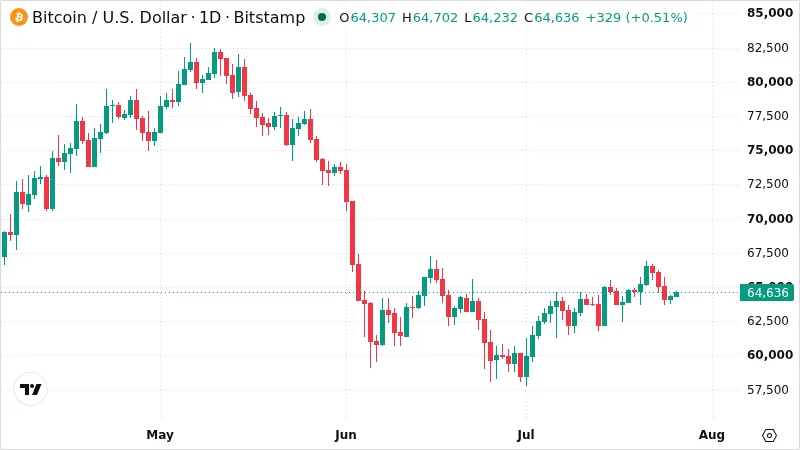
Perhaps most strikingly when looking back at expectations set in March: despite ETF inflows and institutional accumulation being heralded as drivers for sustained growth or even new highs, bitcoin today sits well below not only its March peak but also far beneath its all-time high of $126,080 reached on October 6, 2025. This means that even after what was described as a “historic rally,” bitcoin never came close to challenging its previous record over these months—instead declining and then flatlining for at least a month based on available data.
What the Numbers Actually Show
The current price of $64,643 is approximately $9,857 lower than the $74,500 level reported on March 16—a drop of more than 13% from that moment despite no major volatility indicated in recent weeks. The lack of movement (+0.00% over seven days; +0.09% over thirty days) suggests that whatever forces drove the spring rally have either dissipated or been counterbalanced by selling pressure or wanig demand since then.
The data does not show any continuation toward new highs following the ETF-driven surge; instead it points to a sharp reversal and then an extended period where neither bulls nor bears have asserted control decisively enough to move the price meaningfully in either direction. With bitcoin still ranked first by market cap but trading at roughly half its all-time high from October 2025 ($126,080), it is clear that institutional inflows alone have not been enough to sustain momentum or restore previous levels.
A Broader Perspective: Crypto Cycles and Institutional Impact
The events described in March echo familiar patterns seen throughout crypto history: sharp rallies fueled by new market participants (in this case ETFs and institutions), followed by equally sharp corrections or periods of stagnation once buying pressure subsides or external catalysts fade from view. While spot ETFs were touted as transformative for liquidity and mainstream access—reflected in their rapid accumulation of more than 6% of supply—the subsequent stalling in price suggests that even large-scale institutional involvement cannot override broader market cycles indefinitely.
This dynamic parallels past episodes where narrative shifts (such as “digital gold” during macro turmoil or “DeFi summer” during protocol booms) led to outsized optimism about crypto’s future role—only for prices to retrace once initial excitement met reality or broader risk appetite shifted elsewhere. The fact that bitcoin is still comfortably ranked number one underscores its enduring dominance among digital assets; however, dominance does not guarantee upward momentum if demand plateaus or macro conditions change.
Periods where crypto assets are described as “safe havens” often coincide with heightened volatility elsewhere—but these moments rarely translate into long-term stability or persistent gains without follow-through from both retail and institutional investors.
The Verdict: Did Expectations Match Reality?
Based strictly on available data and our earlier coverage from mid-March: the scenario anticipated—a sustained rally driven by ETF inflows and institutional buying—did not play out as hoped over the subsequent four months. Bitcoin failed to maintain its gains above $74,000 and instead declined by more than 13%, entering a phase with almost no price movement over recent weeks (+0.00% over seven days; +0.09% over thirty days). The much-discussed ETF effect did not prove sufficient to offset whatever selling pressure emerged after March’s highs.
While some elements (such as continued market cap leadership) remain intact for bitcoin, the notion that institutional accumulation would underpin ongoing strength has been invalidated for this period based on concrete numbers alone. Instead of new highs or persistent growth following geopolitical shocks and ETF launches—as was widely speculated at the time—bitcoin has delivered neither breakout performance nor catastrophic collapse since then; it has simply stalled well below both its recent peak ($74,500) and its all-time high ($126,080).