
High-stakes entry for market deployers
Hyperliquid’s latest HIP-4 upgrade has set a steep barrier for those looking to launch their own prediction markets on its decentralized exchange. To deploy a permissionless market, users must stake 500,000 HYPE tokens, which equated to roughly $30 million at the time of the announcement. This requirement is not just a technical hurdle; it’s a financial commitment designed to ensure only serious participants enter the space.
The upgrade, which went live on mainnet in May, currently limits prediction market deployment to validator-approved contracts. However, Hyperliquid plans to expand access by allowing external operators to create their own markets—first on testnet, and eventually on mainnet—once the permissionless system is fully rolled out.
Each deployer will be limited to 100 outcomes at a time, with allocation refreshed as markets settle.
Token slashing enforces market integrity
Deployers who stake 500,000 HYPE are subject to a slashing mechanism if their markets are found lacking. The staked tokens remain locked for six months and can be partially or fully slashed following a validator vote if the deployed market is poorly defined, incorrectly settled, or left unsettled for more than one week. This approach aims to discourage careless or malicious market creation and settlement.
On paper, anyone can open a market—but in practice, only those willing to risk tens of millions in HYPE tokens will qualify.
Validators play an active role here: they retain authority over standardized templates and enforce penalties when necessary. Each deployer is initially limited to 100 outcomes at any one time; once a market settles, that allocation becomes available again. The specifications for this permissionless deployment may still evolve before the feature hits testnet.
Outcome trading debuts on mainnet
HIP-4’s initial rollout introduced “outcome trading” contracts on May 2, integrating these markets into HyperCore, the platform’s native trading engine. These contracts are fully collateralized and settle at either 0 or 1—meaning traders can only lose what they put in, as no leverage is offered. This design makes the system straightforward for users while limiting risks associated with over-leveraged bets.
Currently, all prediction markets are curated by validators. Hyperliquid has stated that ideally there will be fewer than 10 validator-run markets per year once permissionless deployment is live, with most new markets launched by external operators instead. According to cryptoslate.com, this marks a shift from tight validator control toward broader community participation—at least among those able to meet the high capital threshold.
See Also
Revenue split: deployers earn trading fees
Despite the high upfront cost, there is an incentive for deployers: up to 50% of trading fees generated by their markets will go directly to them. This revenue-sharing model could attract institutional players or well-funded teams willing to take on both the financial risk and operational responsibility of running large-scale prediction markets.
Deployers are responsible not only for defining their markets but also for settling them according to criteria specified in standardized templates approved by validators. This dual role means that both technical competence and financial accountability are required from anyone seeking to participate as a market operator under HIP-4.
HYPE token sees modest price bump
Following news of the HIP-4 upgrade and its ambitious plans for permissionless prediction markets, Hyperliquid’s native HYPE token experienced a slight uptick in price. The token rose about 1% after the announcement—from an intraday low of $59.88 up past $60.50—and was recently trading at $60.79.
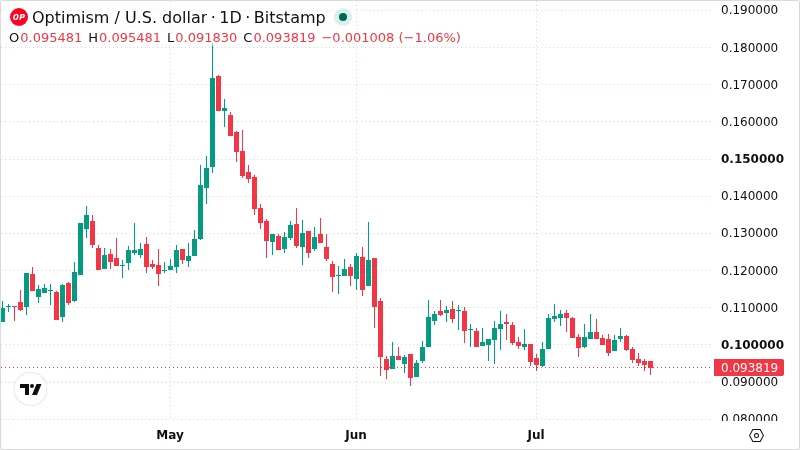
This movement was relatively muted considering the scale of the upgrade and the capital requirements involved. It’s unclear whether traders see this as a sustainable driver or just an initial reaction.
Meanwhile, centralized exchange (CEX) spot volumes climbed 15.3% in June—reaching $1.11 trillion—and RWA perpetual volumes hit a record $311 billion during the same period. While these numbers reflect broader crypto trading trends rather than just Hyperliquid activity, they frame HIP-4’s launch within an environment of renewed trading interest after five months of stagnation.
Key risks to monitor
If Hyperliquid’s permissionless prediction markets, requiring a 500,000 HYPE ($30–32 million) stake per deployer, are launched on testnet as planned following the July 19 statement, any validator vote to slash a deployer’s stake for poorly defined or unsettled markets would immediately lock up or remove substantial capital and could deter further deployments; however, the final specifications for permissionless deployment remain unclear and may change before testnet release.