
What Our Earlier Coverage Reported
On June 20, 2026, our earlier coverage focused on a sharp selloff in Strategy’s STRC preferred equity, which fell to $82.50—17% below its $100 par value—triggered by leverage-driven liquidations.
Why It Mattered Then: Context and Concerns
At the time, the sudden drop in STRC’s price was jarring for investors who had come to expect stability from this high-yield instrument, especially since it was designed to maintain proximity to its $100 par value while paying an annualized 11.5% yield. The selloff was not just notable for its size but also for the trading activity it generated: $941 million in STRC volume and $153 million in SATA volume marked some of the largest trading days on record for these products. This spike in activity came against a backdrop of declining overall exchange volumes, with May’s combined total dropping 3.45% to $4.41 trillion—the lowest since September 2024—suggesting broader market caution or fatigue.
The management decisions amplified unease. Strategy’s shift from monthly to semi-monthly dividends was framed as a way to reduce price swings around ex-dividend dates, but analysts speculated it could signal deeper liquidity or sustainability concerns. This stood in stark contrast to Strive’s SATA, which had just begun offering daily dividends at a higher 13% yield, highlighting a divergence in confidence between similar products. Furthermore, Strategy’s move to repurchase $1.5 billion of its convertible notes depleted its cash reserves to $871 million by May 26, even as it still carried over $8 billion in convertible debt—while Strive had none. This imbalance underscored fears about credit risk and whether Strategy could continue supporting STRC payouts if market conditions worsened.
In short, the episode exposed not just volatility but also fundamental questions about digital credit market structure and risk management.
Comparing Then and Now: What Bitcoin Tells Us
Looking at current market data as of August 16, 2026, bitcoin (BTC) is priced at $62,970 with no change over the last 24 hours and virtually flat performance over both the past week (-0.03%) and month (-0.00%). This is a striking contrast to October 2025 when BTC reached its all-time high of $126,080—meaning that since then, BTC has lost roughly half its peak value. While our earlier coverage did not provide a direct link between BTC price action and STRC performance, the context is important: when the STRC selloff occurred in June, bitcoin was still above $80,000 according to the excerpt. Now that BTC is trading nearly $20,000 lower than it was during that episode—and more than $60,000 off its all-time high—the broader crypto environment appears significantly less exuberant.
BTC has now spent over 310 days below its October 2025 record of $126,080.
The fact that BTC has been essentially flat for both the past week and month suggests a period of stasis or consolidation rather than recovery or further collapse. For digital credit products like STRC that often rely on underlying crypto asset strength for confidence and liquidity backstops, this lack of upward momentum could reinforce investor caution first sparked by the June events.
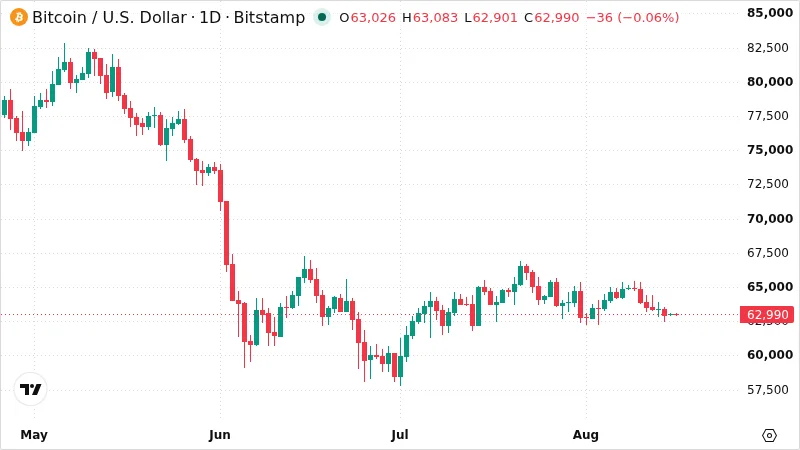
BTC remains ranked #1 by market cap, indicating that despite price weakness relative to its peak, it still dominates the sector in terms of size and influence. However, this leadership has not translated into renewed optimism or significant inflows back into riskier digital credit products like STRC; instead, price inertia may be contributing to ongoing risk aversion among investors who were rattled by recent volatility.
See Also
Implications: What These Numbers Actually Mean
The numbers paint a picture of a sector that has cooled significantly from its highs but has not yet entered a new phase of growth or panic selling. With BTC down approximately 50% from its October 2025 all-time high and showing negligible movement over recent weeks and months (+0.00% over both periods), there is little evidence of either renewed speculative fervor or broad-based capitulation. For instruments like STRC—which saw their stability assumptions shattered when prices plunged below $83—this environment likely means continued skepticism from investors who are now more attuned to liquidity risks and balance sheet vulnerabilities.
The excerpt noted that May exchange volumes had already dropped to their lowest level since September 2024 before the June selloff hit STRC. Given that BTC has failed to rebound meaningfully since then (as shown by its flat trajectory), it is reasonable to infer that overall market participation remains subdued or cautious—a dynamic that would make it harder for leveraged products or those reliant on steady inflows (like high-yield preferred equity) to regain lost ground quickly.
In other words: while there hasn’t been another dramatic crash since June, there also hasn’t been any sign of robust recovery or renewed confidence in digital credit markets.
Broader Perspective: Lessons from Credit Market Shocks
This episode echoes patterns seen in traditional credit markets when leverage unwinds trigger forced selling and expose structural weaknesses—often leading not only to price declines but also lasting changes in investor behavior. The fact that Strategy’s cash reserves shrank so sharply after buying back debt (from an unspecified prior amount down to $871 million) while still holding over $8 billion in convertible debt highlights classic concerns about liquidity mismatches and payout sustainability familiar from corporate bond crises outside crypto.
Moreover, the divergence between Strategy’s approach (reducing dividend frequency) and Strive’s move toward daily payouts at higher yields mirrors how competition can intensify pressure on issuers during times of stress—sometimes prompting riskier strategies or signaling underlying fragility rather than strength. The old article made clear that these contrasts were being closely watched by market participants sensitive to any hint of credit deterioration or management uncertainty.
With bitcoin still far below its all-time high despite retaining top market cap rank—and with no meaningful positive momentum visible—the sector appears stuck between past excesses and future uncertainty. This kind of limbo is common after major deleveraging events: participants become more cautious; issuers face higher scrutiny; volumes remain muted; and recovery can take much longer than expected unless new catalysts emerge.
The Verdict: Did Fears Materialize?
Based strictly on available data as of August 16, 2026—and without any new information on STRC prices or further liquidations—the scenario described in our earlier coverage appears neither fully resolved nor decisively invalidated. The fears about structural weakness and liquidity risk have not been erased by any notable rebound; bitcoin itself remains stagnant well below previous highs; trading volumes were already low before June’s turmoil; and there is no evidence here of renewed investor appetite for leveraged digital credit instruments like STRC.
: while another acute crisis hasn’t erupted since June’s shock episode, neither have confidence nor prices meaningfully recovered based on current data. The warning signs flagged two months ago remain relevant today—and until broader market conditions improve or new data emerges regarding STRC specifically, those concerns are still very much alive.