
Senate Faces Unprecedented Crypto Regulator Picks
For the first time in a year, President Donald Trump has nominated four candidates to fill vacant seats at the Securities and Exchange Commission (SEC) and the Commodity Futures Trading Commission (CFTC), two agencies that have been operating with critical staff shortages. On Thursday, the White House announced Steven Levine and Kristin Johnson as nominees for the SEC, alongside Nathan Anonick and Matthew Rowland for the CFTC. All four nominations require Senate confirmation—a process that will test bipartisan cooperation, since this is also the first instance of Trump putting forward Democratic picks for either commission.
The SEC currently has only two out of five commissioner seats filled, while the CFTC is even more understaffed: Chairman Michael Selig remains its sole member. This vacuum has left both regulators struggling to keep pace with rapidly evolving crypto markets and other financial oversight responsibilities. The Senate Banking Committee will vet the SEC nominees, while the Senate Agriculture Committee will review Anonick and Rowland’s CFTC bids, adding another layer of complexity to an already unusual nomination slate.
Crypto Bill Veterans Up for CFTC
Both CFTC nominees—Nathan Anonick (Republican) and Matthew Rowland (Democrat)—bring direct experience from Capitol Hill, having worked together on the Clarity Act, a crypto market-structure bill that failed in the Senate during fall 2024. Their backgrounds on the Senate Agriculture Committee could prove valuable if confirmed, especially as Congress continues to debate how digital assets should be regulated in the United States. Anonick was nominated for a term ending June 19, 2031, taking over the seat previously held by Rostin Behnam. Rowland would fill out Summer Mersinger’s unexpired term through April 13, 2028.
Their shared legislative history signals a possible shift toward more informed crypto policy at the agency.
Despite their expertise, it remains uncertain whether their presence will speed up clarity for digital asset regulation or simply intensify partisan divides within a historically consensus-driven commission. The fact that both are linked to a failed bill complicates predictions about their immediate impact.
See Also
SEC’s Empty Seats Await Confirmation
At the SEC, Steven Levine (Republican) is set to replace Hester Peirce—who left her post in October—for a term running through June 5, 2030. Levine’s nomination comes at a time when only two of five commissioner seats are filled. Kristin Johnson (Democrat), nominated for a term ending June 5, 2029, would take over from Caroline Crenshaw. Johnson previously served as a CFTC commissioner and developed rules focused on digital asset custody and decentralized finance (DeFi), as well as customer protection frameworks.
This bipartisan pairing stands out under Trump’s administration; according to bitcoinmagazine.com, it marks one of the rare moments Democrats have been advanced for these regulatory roles since 2017. The micro-contrast here is striking: Trump’s willingness to nominate Democrats may signal pragmatism in addressing regulatory gridlock, yet it also highlights how acute staffing shortages have become at both agencies.
The SEC's backlog of enforcement actions and rulemakings has grown due to these vacancies—a fact not lost on industry watchers who see this round of nominations as overdue but essential.
Market Response Muted As TRUMP Token Sits Flat
While regulatory headlines often spark volatility in politically themed tokens, TRUMP (TRUMP) has shown little reaction so far. As of November 14, 2026, TRUMP trades at $1.001—a drop of just -0.08% over 24 hours and -0.16% across seven days. The token’s month-long decline stands at -0.44%, far removed from its all-time high of $73.43 recorded on January 19, 2025. Despite ranking #133 by market cap today, TRUMP’s subdued movement suggests traders are either unconvinced these nominations will reshape crypto policy quickly or are waiting for concrete Senate action before making big bets.
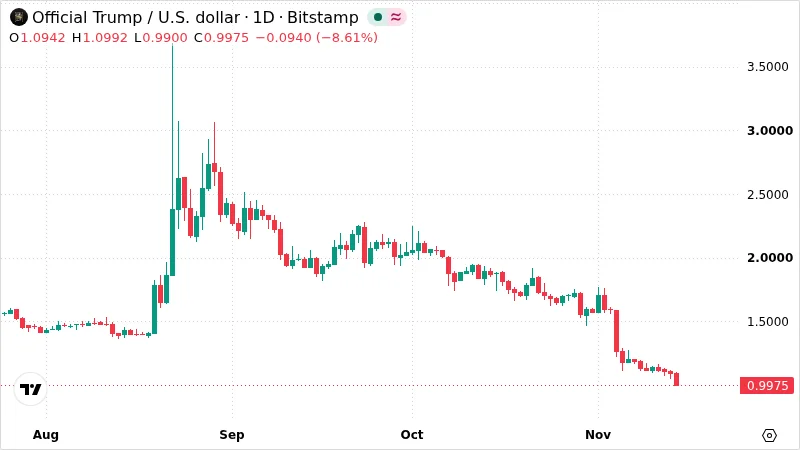
Investors may be weighing whether bipartisan appointments can break through Washington inertia or if gridlock will persist regardless of who fills these seats.
With all four nominees requiring Senate confirmation—and with each slated for terms ranging from April 2028 through June 2031—the timeline for any tangible regulatory change remains uncertain. The crypto industry may see new faces soon at both agencies’ tables, but whether this translates into meaningful shifts in oversight or enforcement is still up in the air.
Key signals ahead
If the Senate confirms Trump’s four nominees—Steven Levine and Kristin Johnson for the SEC, Nathan Anonick and Matthew Rowland for the CFTC—both commissions could regain quorums after operating with only two of five SEC seats filled and just one CFTC commissioner; immediate restoration of voting capacity would follow confirmation, but timing of Senate action remains unclear.