Trump’s Ethics Concessions Tip the Scales
In a bid to secure enough Senate support for the Clarity Act, President Donald Trump has agreed to a set of stricter ethics rules, including expanded conflict-of-interest provisions and new state-level enforcement powers. These concessions were negotiated to win over key Senate moderates whose votes are pivotal for the bill’s passage, as reported by coindesk.com citing the Associated Press. The move marks a significant shift from earlier drafts, which had faced resistance over perceived loopholes and lack of oversight.
The expanded conflict-of-interest rules would apply not only to federal officials but also create mechanisms for states to investigate and enforce ethical breaches related to crypto regulation. This dual-layered approach was seen as necessary by several senators who had withheld support pending tougher accountability measures. For Trump, agreeing to these terms is a calculated risk—balancing industry demands for regulatory clarity with lawmakers’ calls for greater transparency and public trust.
Trump’s agreement to state-level enforcement was confirmed by the Associated Press on September 13.
State Powers: The Key Senate Ask
One of the most contentious elements in negotiations has been the question of state authority. Trump’s acceptance of state-level enforcement powers directly addresses concerns from senators representing states with active crypto sectors, who argued that federal oversight alone would be insufficient. By allowig state attorneys general to pursue violations, the revised bill aims to provide an additional check on potential abuses within digital asset markets.
Yet this compromise also introduces new complexities. State enforcement could lead to a patchwork of interpretations and actions across jurisdictions, potentially complicating compliance for national crypto firms. The tension between uniformity and local autonomy is now baked into the legislative process—a micro-contrast that reflects broader debates over how much control Washington should cede to individual states in regulating emerging technologies.
Senate Vote Date Still in Flux
Despite these high-stakes concessions, the Clarity Act’s future remains uncertain. The Senate vote is officially scheduled for September 15, but there is no guarantee it will proceed as planned. Lawmakers have signaled that procedural delays or last-minute amendments could push the vote back, or even see the bill reintroduced in modified form later in the session.
No one can say with certainty whether September 15 will bring resolution or more gridlock.
This uncertainty weighs heavily on both industry participants and policymakers. With each day of delay, market participants are left guessing about what regulatory environment they will face—and whether today’s compromises will hold if negotiations drag on past this week.
See Also
Crypto Bill Faces Fed Rate Crosswinds
The timing of the Clarity Act vote coincides with another major event: the Federal Reserve’s latest interest rate decision, set for Wednesday of this week. The Fed is widely expected to raise its benchmark rate by 25 basis points, bringing it up to a range of 3.75%–4%. A week ago, CME Group’s FedWatch Tool showed a more than 40% chance of a rate pause; now those odds have dropped sharply to just 13.3%. This rapid shift in expectations adds another layer of volatility for digital assets already grappling with regulatory ambiguity.
Meanwhile, macroeconomic headwinds persist. Oil prices have surged above $100 per barrel, and U.S. consumer inflation expectations have climbed to 4.6% over the coming year according to recent data from The Kobeissi Letter. For Bitcoin (BTC), these crosscurrents have contributed to its trading below key weekly support levels as September enters its third week—underscoring how intertwined monetary policy and crypto regulation have become.
Why It Matters: TRUMP Token Holds Steady Amid Uncertainty
Against this backdrop, price action in tokens linked to political narratives offers a real-time gauge of sentiment around both policy and personalities. The TRUMP token currently trades at $2.04 as of September 14, reflecting a modest 0.03% gain over 24 hours but a slight dip of -0.12% over seven days. Over the past month, however, TRUMP has managed a small increase of +0.41%, suggesting that traders are neither panicking nor piling in ahead of next week’s pivotal events.
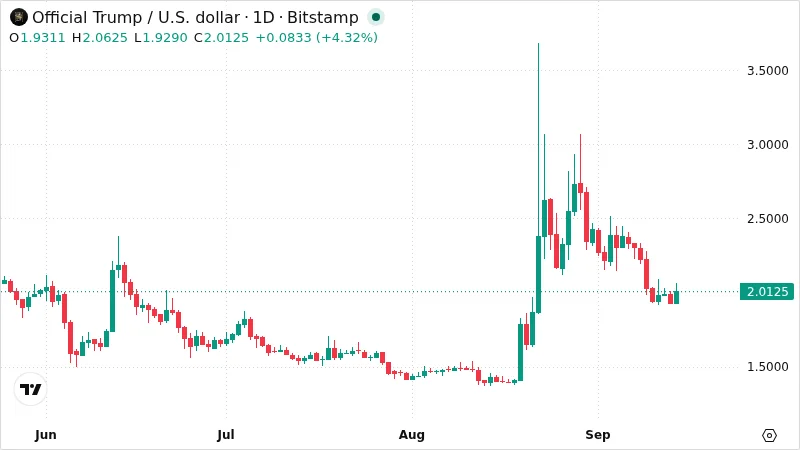
The contrast is stark when viewed against its all-time high: TRUMP reached $73.43 back on January 19, 2025—a level far removed from today’s subdued trading environment and evidence that speculative fervor has cooled dramatically since then.
Market reaction has been muted despite headline-grabbing developments in both Washington and Wall Street.
For investors tracking legislative momentum as well as macro signals like Fed policy shifts and inflation expectations, this period feels like suspended animation—waiting for either decisive action or renewed paralysis from Capitol Hill.
Factors to watch closely
If the Senate holds the scheduled Clarity Act vote on September 15, following Trump’s agreement to stricter ethics and state-level enforcement rules to secure key votes, the bill could advance immediately; however, if the vote is delayed or does not occur as planned, its legislative path remains unclear.