
Traders Snag Bitcoin at Fire Sale
On Friday night, a rare and dramatic event unfolded on Kraken’s Canadian dollar (CAD) market: Bitcoin briefly traded for as low as $17,000—more than 70% below its concurrent price on the exchange’s U.S. dollar market. This sharp drop began around 20:00 UTC and culminated during a five-minute window early Saturday morning, when the BTC/CAD pair plummeted to roughly C$24,250. At the same moment, Bitcoin’s price against the U.S. dollar on Kraken hovered between $57,277 and $58,030, never dipping below $55,100.
The result was a windfall for some traders who had lowball buy orders in place or acted quickly during the chaos. Approximately 616 BTC changed hands on the BTC/CAD pair between Friday afternoon and early Saturday morning, locking in extraordinary profits for buyers able to arbitrage between markets or simply resell at prevailing global prices.
Kraken’s CAD order book saw every coin cut by over 70% in price during the overnight breakdown.
Why These Wild Prices Will Stand
Kraken confirmed that all trades executed during this flash crash will be honored. The exchange stated its platform “processed every order correctly” and found “no sign of a breach or compromised accounts.” In other words, even though Bitcoin temporarily traded at just $16,900—about 71% below the then-global price—the exchange will not reverse or unwind any of these transactions. This stance has left those who sold at rock-bottom prices frustrated, while buyers who scooped up cheap coins have seen their gains locked in by policy.
According to unchainedcrypto.com, Kraken’s support account acknowledged that CAD pairs saw “heavy selling pressure that pushed prices well below other markets” starting late Friday. Yet despite speculation about technical glitches or security incidents, Kraken maintains that its systems functioned as intended throughout the selloff.
Kraken Dodges Blame, Traders Left Reeling
The sudden plunge in the BTC/CAD pair was not mirrored elsewhere on Kraken’s platform or across major exchanges. During the same period when CAD-priced Bitcoin crashed to C$24,250 (roughly $17,000 USD), the BTC/USD pair remained stable near $57,650. This discrepancy has fueled debate about what triggered such an extreme divergence between trading pairs.
Kraken insists no technical error occurred and has not offered compensation to sellers affected by the drop.
Blockstream CEO Adam Back publicly speculated that a market maker may have exhausted its funds on Kraken’s USD/CAD spot market, causing prices to decouple from reality. However, with no confirmation from Kraken itself and no official explanation beyond “heavy selling pressure,” uncertainty lingers over how such a significant liquidity gap emerged in one of crypto’s most liquid assets.
Winners and Losers in the Flash Crash
The fallout from this event created clear winners and losers. Arbitrageurs or opportunistic traders who managed to buy BTC at sub-$20K levels on Kraken’s CAD book could immediately resell at global rates—potentially pocketing tens of thousands of dollars per coin. For sellers whose orders were swept up in the collapse, however, there is little recourse; Kraken’s policy is unequivocal that “executed trades stand.”
By around 5 a.m. ET Saturday—just hours after hitting its nadir—the BTC/CAD pair had rebounded to approximately C$80,000. This rapid recovery underscores how localized and short-lived the disruption was; it also highlights how quickly liquidity can return once extreme imbalances are corrected by market forces.
Yet while some traders reaped enormous profits from Kraken’s pricing anomaly, others faced steep losses with no prospect of reversal—a stark reminder of both risk and opportunity in crypto markets.
The Mystery Behind the CAD Meltdown
One crucial detail adds further complexity: during the crash period, Kraken’s USD/CAD trading pair itself experienced wild swings—falling from near 1.43 (in line with the Bank of Canada reference rate) to as low as 0.30 overnight. Such a breakdown in fiat conversion rates likely amplified volatility across all CAD-denominated pairs on the platform.
Despite extensive scrutiny from users and media outlets alike, it remains uncertain whether this episode was purely driven by aggressive selling or if deeper structural issues within Kraken’s order book design played a role. The absence of any confirmed technical malfunction leaves open questions about safeguards against similar events in thinly traded currency pairs.
Context: Bitcoin Steady Elsewhere
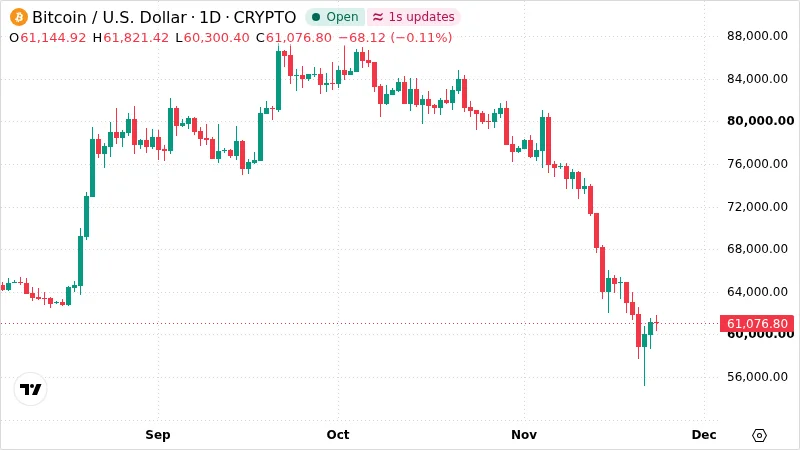
While this drama played out on one exchange and one fiat pairing, Bitcoin itself has been notably steady in recent months. As of November 23rd, BTC trades at $61,266—essentially unchanged over 24 hours (+0.01%), down just -0.05% over seven days and -0.24% for the month. Despite reaching an all-time high of $126,080 last October, current volatility is muted compared to prior cycles.
This stability across most venues stands in stark contrast to last weekend’s flash crash on Kraken’s CAD book—a microcosm of how local liquidity shocks can still produce outsized moves even when global sentiment is calm.
Factors that could still shift
If Kraken provides further comment or confirms whether a market maker on its USD/CAD spot market exhausted its funds during the heavy selling pressure that began around 20:00 UTC on Friday, it could immediately clarify the cause of the 71% price drop and inform whether similar order book breakdowns remain a risk; as of publication, Kraken has not yet confirmed this explanation and has not responded to Cointelegraph’s inquiry.