
Softer Core Inflation Fails to Lift Crypto
Bitcoin’s price action barely budged after the May Consumer Price Index (CPI) report, even as core inflation came in softer than many had feared. The Bureau of Labor Statistics reported a 0.
Despite these numbers, Bitcoin hovered just above $61,000 following the data release, almost unchanged ovre a 24-hour period. This muted reaction stands in contrast to the strong moves often seen in risk assets when inflation surprises occur. On paper, a softer core CPI might have encouraged more risk-taking—but Bitcoin’s price remained stubbornly flat.
The May core CPI increase of 0.2% was below the 0.3% forecast and down from April’s 0.4% rise.
The lack of momentum hints at a market searching for direction amid persistent macroeconomic uncertainty.
Treasury Yields Jump as Bitcoin Flatlines
While Bitcoin traded near $61,000 after the inflation report, U.S. Treasury yields told a different story. The benchmark 10-year yield climbed to 4.5% on the day of the CPI release, reflecting expectations that interest rates may stay higher for longer as inflation remains above the Federal Reserve’s 2% target. CME Fed fund futures showed traders pricing in a year-end rate at least 25 basis points above the current 3.50%-3.75% range.
Other risk assets didn’t fare much better: gold fell roughly 3%, nearing $4,100 per ounce, while both the S&P 500 and Nasdaq 100 slid about 1%. Even oil prices saw volatility—West Texas Intermediate (WTI) crude dropped 1% to $88 per barrel on one day, but also spiked over 3% to $91.11 per barrel during heightened geopolitical tensions.
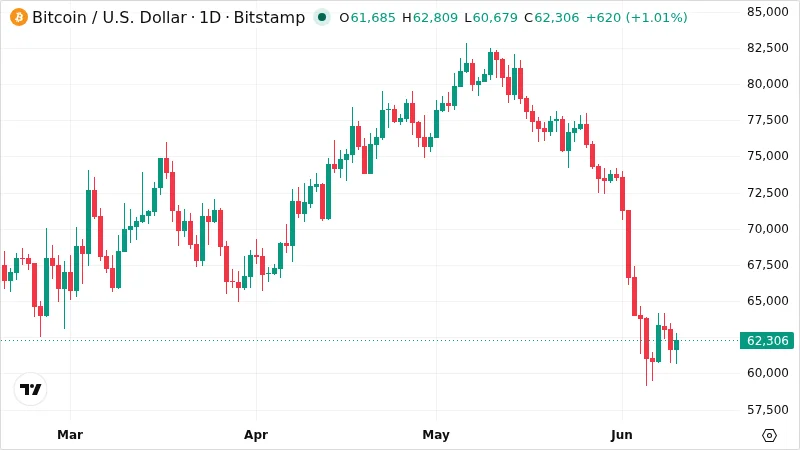
Bitcoin’s resilience was tested by these crosscurrents but ultimately left it unmoved.
See Also
Rate Hike Bets Weigh on BTC Bulls
For crypto traders, the main concern remains monetary policy rather than headline inflation numbers alone. The Federal Reserve’s target rate is still well below current CPI readings—headline inflation rose 4.2% year-over-year in May—and with futures markets suggesting another hike by year-end, risk appetite is being suppressed across digital assets and traditional markets alike.
On Wednesday, Bitcoin traded at $61,233, down about 3% over the previous day and nearly 7% on the week. Ether (ETH) slid 3.4% to $1,625 and Solana (SOL) dropped over 4% to $64.24 according to coindesk.com data. Even so-called “hedges” like gold failed to offer shelter; its price tumbled below $4,200 an ounce during the same stretch.
Over $500 million in bearish bets were liquidated in a short squeeze—the highest such figure since April—highlighting just how quickly sentiment can shift when volatility strikes.
Inflation Data Offers No Clear Signal
It’s unclear whether May’s softer core CPI will be enough to shift central bank policy or revive bullish momentum for Bitcoin in the near term. While oil prices have dropped more than 16% over the last month and the CBOE Oil Volatility Index has returned to pre-war levels, broader financial conditions remain tight.
The divergence between asset classes is striking: while equities and gold have weakened alongside Bitcoin this week, Brent crude has held near $92 a barrel and Treasury yields continue their upward march. For now, traders are left watching for clearer signals from both inflation data and central bank commentary before making their next move.
Markets remain cautious—and so does Bitcoin.
Signals yet to emerge
If Bitcoin falls below the $60,000 threshold—having traded near $60,930.61 after the May CPI release and with over $500 million in bearish bets recently liquidated—it would immediately signal renewed downside pressure amid ongoing inflation concerns and rate-hike bets; whether this level holds or breaks remains unclear.