
Ripple’s RLUSD Gains OCC Green Light
Ripple has secured final approval from the U.S. Office of the Comptroller of the Currency (OCC) for its national trust bank, a move that cements its stablecoin ambitions. The green light allows Ripple National Trust Bank (RNTB) to manage reserves backing Ripple USD (RLUSD), act as collateral trustee for RLUSD holders, and offer digital asset custody services. This follows conditional approval granted in December 2025, closing a lengthy regulatory process and positioning Ripple to play a larger role in the U.S. stablecoin market.
The timing is notable: RLUSD, which launched in December 2024, has already amassed a market capitalization of about $2.6 billion, according to CoinGecko data cited by decrypt.co. Most of these reserves are held in Treasury bills and other short-term U.S. government assets, with BNY Mellon acting as a primary custodian. Eligible institutional holders can redeem RLUSD at par within two business days—a key feature for large-scale financial operations.
Robinhood Bets on Competing Stablecoins
Robinhood’s approach to stablecoins is marked by a notable duality: while it is part of the consortium promoting USDG (issued by Paxos), it is also preparing to roll out RLUSD to its 28.6 million funded accounts globally later this year.
The Global Dollar Network, established in 2024, includes Robinhood alongside Kraken, Galaxy Digital, Anchorage Digital, Bullish, and Arbitrum—all backing USDG as their preferred stablecoin for onchain lending and settlement. In July, Robinhood named USDG as the default asset for its Robinhood Earn product. Yet despite this alignment, RLUSD is set to become available through the Robinhood app before the end of 2026 and is already live on Robinhood Chain and Bitstamp (which Robinhood acquired for $200 million in June).
This dual strategy sets up a quiet rivalry between two dollar-backed tokens inside one of crypto’s largest retail platforms.
See Also
RLUSD Lands in Institutional Settlement Flows
Ripple’s partnership with Robinhood extends beyond retail customers into institutional settlement. Robinhood plans to use RLUSD on the XRP Ledger for settling large transactions between institutions—a move aimed at streamlining cross-border payments and liquidity flows. The integration will be managed via Ripple Treasury, an enterprise solution designed to handle global cash management tasks such as payment processing, forecasting, and intercompany transfers.
Additionally, Ripple has expanded its relationship with BNY Mellon to allow custody of both XRP and RLUSD on BNY’s Digital Asset Custody platform. The plan includes enabling BNY clients to mint and redeem RLUSD directly through the bank—potentially reducing friction in stablecoin issuance and redemption processes for institutional users.
Meanwhile, financing platform C2FO is piloting settlement of its Instant Pay service on the XRP Ledger using RLUSD, with initial transactions expected by year-end 2024.
XRP Ledger Powers Ripple’s Retail Push
The XRP Ledger underpins much of Ripple’s expansion into retail and institutional markets. Nearly $1 billion worth of RLUSD has been issued on the ledger so far, representing a significant share of its total $2.57 billion market cap as tracked by DeFiLlama. This focus on blockchain-native infrastructure aligns with Robinhood’s plans to bring RLUSD directly into its app ecosystem later this year.
Yet there is nuance: while XRP itself remains among the top five cryptocurrencies by market cap (currently ranked fifth), its price performance has been muted compared to earlier cycles. As of October 28, 2026, XRP trades at $1.32—up just 0.01% over 24 hours and down slightly over both seven-day (-0.02%) and thirty-day (-0.11%) periods. The token last reached an all-time high of $3.65 in July 2025.
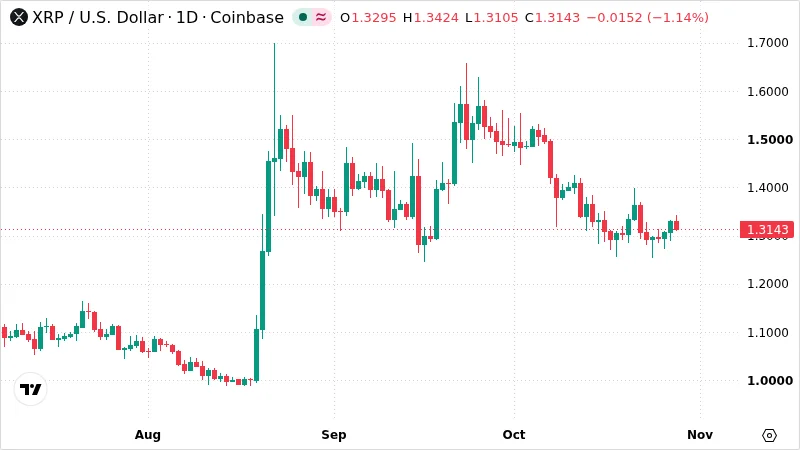
Investors may see upside potential in new settlement flows via RLUSD, but recent price action suggests caution persists.
Why It Matters: Practical Impact Beyond Hype
Moody’s Ratings recently assigned an A2 long-term deposit rating to RLUSD—a level considered investment grade—reflecting confidence in its underlying reserves held mainly at BNY Mellon and backed by short-term U.S. government assets. However, Standard Custody & Trust Company (the issuer) is not bankruptcy remote; holders do not have direct ownership interest in reserves today, though new U.S. law slated for 2027 will change that landscape by excluding required reserves from bankruptcy estates.
The OCC approval gives Ripple a formal banking foothold but does not mean deposit-taking or loan-making authority; most national trust banks operate without FDIC insurance or traditional banking functions per OCC guidelines. Circle received similar approval earlier this year; Coinbase and others remain at conditional stages.
The headline numbers around RLUSD adoption are striking—$2.5 billion+ market cap within less than two years—but Robinhood’s support for both USDG and RLUSD reveals a more complex competitive landscape than headline figures suggest.
What to monitor next
The market will watch for the launch of RLUSD on the Robinhood app, scheduled for later in 2024; if this rollout occurs as planned, RLUSD will become accessible to Robinhood’s 28.6 million funded customers immediately upon release.